Bees Are the World’s Quiet Infrastructure: How Pollinators, Disease, and Climate Collide
Published: June 23, 2026
Introduction: What “Bees” Are—and Why They Matter in Detail
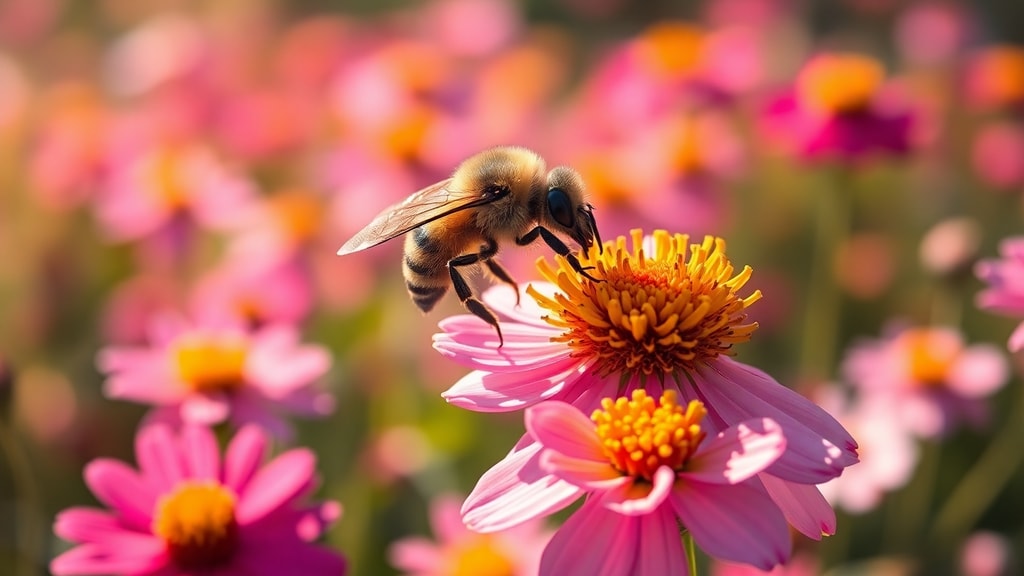
nBees are a diverse group of insects—more than 20,000 known species—belonging to the order Hymenoptera and predominantly to the superfamily Apoidea. While the public often thinks of honey bees, *Apis* species are only one part of a much larger community. The vast majority of bees are **wild bees**: solitary species that nest in soil, stems, or cavities, rather than forming hives. Their lifestyles and ecological roles vary widely, from ground-nesting miners to cavity-using carpenter bees and social bumblebees.
Bees’ importance stems from their **pollination services**. As they forage for nectar and pollen, they transfer pollen grains between flowers. This is not merely incidental feeding behavior; it is an evolutionary partnership shaped by plant reproduction and insect foraging. Many crops rely on insect pollination, and in many ecosystems wild plants depend heavily on bees to set seed and maintain genetic diversity.
Consider the structural effect bees have across landscapes: bees help stabilize yields for fruits, nuts, vegetables, and seed crops, while also supporting the plant diversity that underpins entire food webs—from herbivores to predators. In ecological terms, bees contribute to **resilience**. Where pollinators are diverse, ecosystems can better withstand shocks such as droughts, temperature spikes, and plant disease outbreaks.
Bees also function as indicators of environmental stress. Because they are tied to flowering phenology—the timing of bloom—and require particular pollen and nectar resources, disruptions to climate patterns or habitat quality can quickly show up in bee abundance, behavior, and reproductive success. When bees struggle, it is rarely an isolated problem; it is usually a signal that the broader system is under strain.
The Catalyst: Why Bees Are Trending Right Now
Bees are trending because multiple high-visibility signals are converging at once:
1) **Climate volatility is intensifying.** Recent years have brought more frequent heat extremes, irregular rainfall, and shifting bloom calendars. For bees, timing is everything. If flowers bloom earlier or later than usual, bees can emerge at the wrong moment—missing peak nectar availability or leaving larvae without adequate food.
2) **Disease and parasites remain a live threat.** Managed honey bees face persistent pressures such as the parasitic mite *Varroa destructor*, which weakens colonies and creates a pathway for viruses. Even where treatment occurs, the interaction between genetics, management practices, and environmental stress can tilt outcomes.
3) **Public attention is rising due to local and national policy debates.** Cities and regions are increasingly discussing pesticide regulation, habitat corridors, and native planting requirements—often in response to observed declines in pollinator populations.
4) **Viral and documentary-style coverage has turned “bee decline” into a mainstream story again.** Social media and journalism have amplified stories about colony losses, odd weather patterns, and the search for new monitoring technologies.
Together, these triggers have refocused attention on bees not as a niche conservation concern, but as a core element of food security and ecological stability.
Deep Dive: Historical Context, Analytical Reality, and Second-Order Implications
n### A brief history of bee value—then a correction
For much of modern agricultural history, bees were treated as a controllable input: install hives, rent pollination services, and manage colony health. That approach produced measurable gains in crop set and yield consistency. Yet the modern reality is more complex. Pollination is not simply a commodity; it is a biological service distributed across space, time, and species.
Wild bees are particularly important because they can be more responsive to local conditions and can forage under different temperature and weather windows than many honey bees. In some settings, wild bees contribute disproportionately to pollination of specific crops or native plants.
The second-order problem: when multiple stressors overlap
The most damaging declines in bees rarely result from a single villain. Instead, multiple pressures interact:
The second-order implication is that bees can appear “fine” in short observation windows while still being biologically compromised. A colony might maintain numbers yet fail to produce robust brood, or wild bee populations might persist in refuges but collapse in the broader landscape.
Monitoring is changing from guesswork to near-real time
One reason bees are again at the center of research is the shift toward better measurement. Scientists and citizen science groups are increasingly using:
These tools help convert “decline narratives” into quantifiable risk forecasting. Instead of asking only whether bees are declining, researchers increasingly ask **where**, **when**, and **why**.
Why bee ecology also matters for biodiversity and carbon
Bee conservation is often discussed in relation to crops, but the broader ecological implications extend further. When pollinators decline, plant reproduction can shift, affecting habitat quality for birds, insects, and mammals. Reduced plant diversity can then reduce ecosystem functions that influence carbon storage, water retention, and soil stability.
In other words: bees are not only a food system input. They are a **keystone connective tissue** linking biodiversity to the physical stability of ecosystems.
Future Outlook: Bob’s Prediction on Where Bees and Policy Are Headed
nAs I see it, the next phase of the “bee story” will be less about single solutions and more about **systems management**—the coordinated redesign of landscapes, agricultural practices, and monitoring infrastructure.
My forward-looking prediction: within the next decade, regions with serious pollinator strategies will move from voluntary planting and occasional hive management to **measurable pollinator performance targets**. Expect expanded requirements for native flowering corridors, pesticide risk assessments tied to seasonal bee exposure windows, and stronger integration of weather-and-forage prediction into farm planning.
On the technology side, the most likely breakthrough won’t be a single miracle product. It will be **decision support**: tools that help beekeepers and farmers anticipate stress periods, optimize habitat layouts, and detect disease risks earlier. In the best cases, these systems will make bee health a continuous operational metric—similar to how irrigation or fertilization is managed.
Bees will not be saved by one intervention. They will be saved—if at all—by aligning the natural rhythms of flowers, the biology of bees, and the realities of a warming, volatile climate. That alignment is hard work, but it is also the clearest path to protecting both biodiversity and the harvest.