Crude: The World’s Unrefined Backbone—Why Oil Is Back in the Spotlight
Published: June 29, 2026
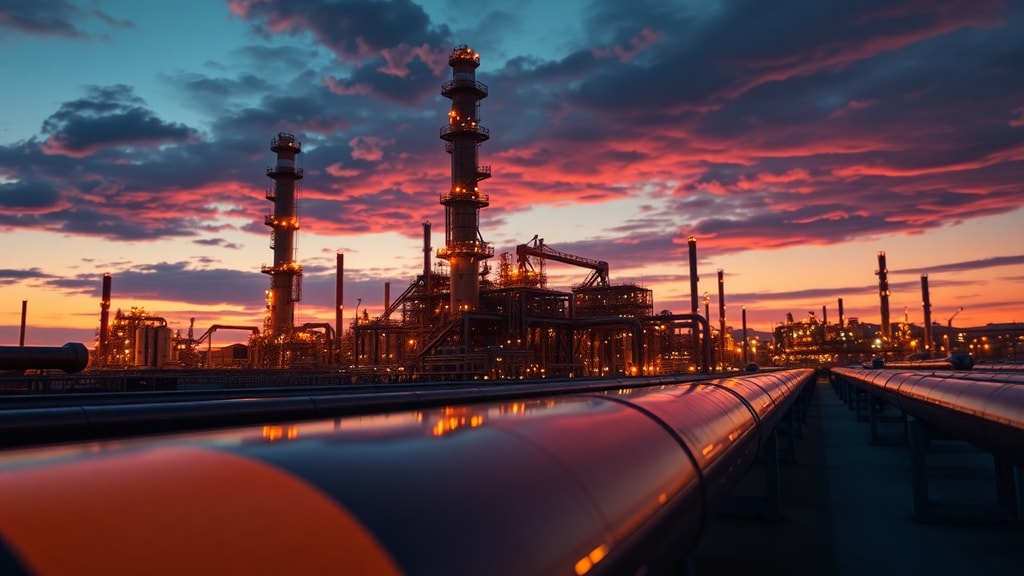
1) Introduction: What “Crude” Actually Means
In energy markets, **“crude”** refers to **crude oil**—a naturally occurring liquid mixture of hydrocarbons found underground (and, in some cases, beneath the ocean floor). It is called “crude” because it is **not yet refined**: it has not been processed into the usable products that consumers and industries rely on daily.
Crude oil varies widely by origin and chemical composition. Two widely referenced measures help describe it:
Once extracted, crude is transported—typically via pipelines, tankers, or rail—to refineries. There, it is processed through a sequence of industrial steps (most notably **distillation** and **conversion**). The crude is separated and transformed into products such as:
Critically, crude oil is not just a fuel—it is an **economic and industrial foundation**. Even when public attention focuses on gasoline at the pump, the underlying reality is that crude also fuels the supply chains for transportation, agriculture, manufacturing, construction, and chemicals. That is why crude remains central to both policy debates and market volatility.
2) The Catalyst: Why Crude Is Trending Right Now
Crude is trending again because the market is currently dealing with a **stacked set of pressures** rather than a single story.
In recent months, several developments have converged:
1. **Geopolitical risk premium**: Tensions across major oil-producing regions have periodically threatened supply continuity. Even when physical supply is not immediately disrupted, traders often price in uncertainty—raising risk premiums.
2. **Refinery constraints and margin swings**: Refineries do not move in a straight line. Planned maintenance, unplanned outages, and changing regulations can tighten the flow from crude to finished products. When refining margins shift quickly, the demand for certain crude grades can surge or collapse.
3. **Changing demand expectations**: Markets are recalibrating demand based on evolving macroeconomic data—growth, inflation, interest rates—as well as transportation patterns and seasonal shifts.
4. **Volatility in futures and currency effects**: Oil is priced globally, with **US dollars** playing a major role. When the dollar strengthens or weakens, crude prices can react even if physical fundamentals are unchanged.
Put simply: the reason crude is “trending” is that it is acting like a live barometer. Traders, policymakers, manufacturers, and even consumers are watching it because it affects costs—directly and indirectly—across the economy.
3) Deep Dive: Context, History, and Second-Order Implications
A. A short history of crude’s power
Crude oil became the dominant global energy source in the twentieth century, displacing older fuels due to its energy density and versatility. The leap wasn’t merely extraction—it was **refining and distribution infrastructure**. Once pipelines, tanker routes, and refinery complexes scaled up, crude could be moved and converted at industrial speed.
Over time, crude markets evolved into a layered system:
Crude prices emerged as the financial “front end” of this entire chain. But crucially, the crude price alone does not determine product prices; refinery capacity, product demand, and regional inventories do.
B. Why “crude” is not one market but many
A common mistake is treating crude as a single commodity with a single supply story. In reality, crude is more like a **portfolio** of grades and origins.
This is why crude differentials—price differences between benchmark crudes—can shift dramatically. Those differentials can signal refining bottlenecks, regional supply disruptions, or changing product demand.
C. Second-order implications: beyond energy prices
Second-order effects are where crude becomes truly consequential.
**1) Inflation dynamics and cost-of-goods transmission**
Crude influences transportation fuels and industrial feedstocks. When crude rises, it can eventually show up in freight costs, manufacturing inputs, and downstream product pricing. The transmission is not instantaneous, but it is persistent.
**2) Geopolitics and leverage**
Because crude is linked to revenue for producer states, it can become a tool of geopolitical leverage. High prices can fund budgets and strategic initiatives, while low prices can strain them. This can affect international diplomacy in ways that are difficult to model but visible in policy choices.
**3) Industrial strategy and refinery investment**
Refineries are capital-intensive. When margins favor certain crude grades, investment decisions follow—slowly. Over time, this can reshape which regions are competitive and which become stranded with less suitable infrastructure.
**4) The energy transition—an unintended coupling**
Even as renewable power and electrification expand, crude remains relevant. The transition is uneven: petrochemicals, aviation fuel, industrial heat, shipping fuel logistics, and certain materials keep crude in the system. That means crude is not “leaving” quickly; it is being renegotiated.
D. The analytics traders and analysts watch
While the average person sees a headline crude price, professionals track a dashboard of indicators:
When these indicators move together, crude volatility tends to accelerate.
4) Future Outlook: Bob’s Prediction on Where Crude Goes Next
From a global trend perspective, I expect **crude to remain structurally volatile**—not because the world will run out of oil soon, but because the system is being forced to operate amid constant friction: geopolitics, refining bottlenecks, regional grade constraints, and shifting demand patterns.
My forward-looking prediction is this: **the market will increasingly price “crude quality and logistics” as much as “crude supply.”** In other words, the spotlight will move from a single headline number toward a more granular view—where certain grades, routes, and refinery configurations determine who benefits and who pays.
Over the next phase, expect:
Crude will not be merely a commodity headline. It will continue to be a **strategic signal**—a measure of how the global economy is coping with scarcity of certainty, not scarcity of molecules.