Fabio Cannavaro: How a Defender Became a Global Template for Leadership in Football’s AI-Era
Published: June 23, 2026
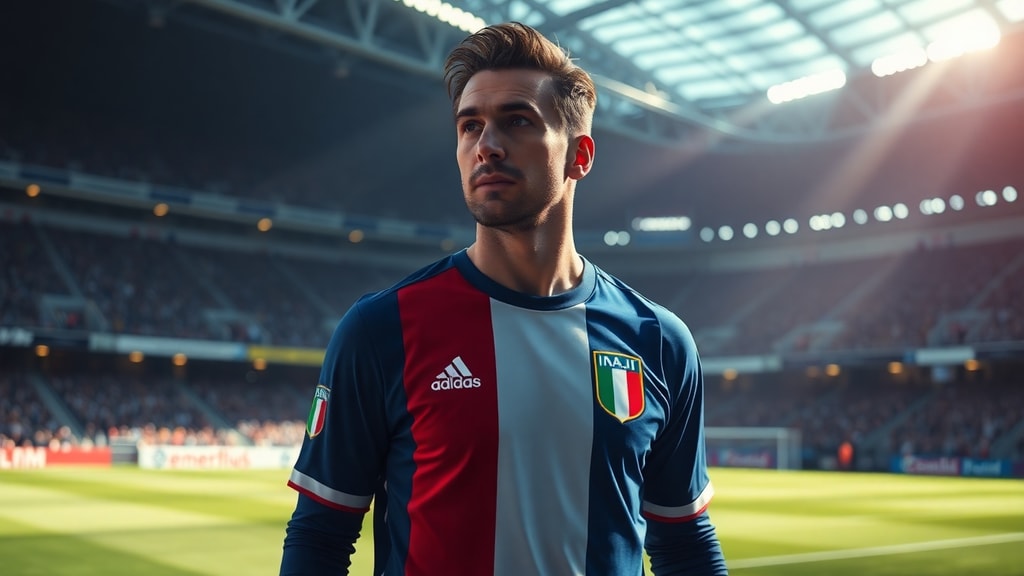
1) Introduction: Who Fabio Cannavaro Is—And Why His Name Still Carries Weight
Fabio Cannavaro is an Italian football icon best known for his elite defensive craft, positional intelligence, and the emotional authority he brought to the sport during his peak. Born on September 13, 1973, in Naples, Cannavaro developed as a classic Central Defender—front-footed in his reading of danger, precise in his timing, and unusually calm for a player operating at the sharp end of high-stakes matches.
During his playing career, Cannavaro became the defining figure of a generation of defenders who could combine physical control with tactical clarity. He won major club honors and international acclaim, but his global recognition exploded in the mid-2000s when he anchored Italy’s defensive structure to championship success. His leadership was not merely ceremonial. On the pitch, he functioned as a conductor: organizing the back line, setting the tempo of transitions, and communicating risk to teammates in real time.
The pinnacle of his international prestige arrived when he was named FIFA World Player of the Year in 2006, an honor that carried exceptional significance for defenders—an acknowledgment that defensive excellence, when executed at the highest level, can dominate the narrative of the entire match. He later added another dimension to his public identity when he transitioned from player to pundit and then to coaching roles, where the question became not only “What did he do on the field?” but “Can his principles scale to a new era?”
In other words, Cannavaro is not simply remembered as a former center-back. He remains a living reference point for how elite defending can be translated into leadership—especially in a modern football environment where teams now treat tactics as systems, not improvisations.
2) The Catalyst: Why “Cannavaro” Is Trending Right Now
Cannavaro is trending again because football media is currently re-centering the conversation around *defensive mastery*—a topic that has resurfaced due to several overlapping catalysts across the sport.
First, the post-2020 acceleration of data analytics and advanced scouting has created a backlash against purely flashy narratives. Fans and analysts are increasingly asking why certain teams consistently neutralize opponents even when they don’t look “dominant” on highlight reels. That question naturally draws attention to defenders whose reputations were built on structure, anticipation, and decision-making under pressure—qualities Cannavaro embodied.
Second, the current cycle of coaching appointments and tactical experiments has renewed interest in leadership models that can stabilize teams through uncertainty. In recent months and seasons, many clubs have sought managers who can impose order: clear defensive shapes, disciplined pressing cues, and predictable rest-defense organization. Cannavaro’s public presence—through commentary, interviews, and coaching-related discussions—has made him a frequent reference for those criteria.
Third, social media has amplified historical comparison clips: match sequences and tactical breakdowns of 2006-era Italy-style defending—especially moments involving line control, off-ball positioning, and collective restraint. When these clips circulate, they do more than entertain; they educate a new audience. For many viewers, Cannavaro becomes a shorthand for “the defender who made the team feel safer,” a contrast to the chaos-driven, highlight-first modern attention economy.
Put simply: Cannavaro is trending now because football is rediscovering that defense is not the absence of offense—it is the engine of confidence. And his specific brand of leadership fits that new obsession with controllable systems.
3) Deep Dive: Historical Context, Tactical Meaning, and Second-Order Implications
Cannavaro’s defensive profile is often described using the language of “great defending,” but that phrase can become lazy. The real lesson is that his defending was *methodical*. He combined three core capabilities:
1. **Anticipation over reaction.** Cannavaro’s best moments often began before the opponent truly struck. He read body orientation, checked the angle of approach, and positioned himself to eliminate the most dangerous lane.
2. **Timing with restraint.** He didn’t chase every tackle. He judged when to step, when to delay, and when to hold the line. That difference—between pressing the ball and managing the space—separates amateurs from operators.
3. **Command and communication.** A back line is only as good as its internal language. Cannavaro played like a quarterback for the defense: reorganizing teammates and resetting shape after disruptions.
To understand why this matters now, we need to place Cannavaro into football’s historical arc. Traditional defender greatness was once judged mainly through visible outcomes: clearances, tackles, goals prevented. But modern football increasingly evaluates defenders through *process metrics*—events and patterns that signal how consistently a team controls risk.
What makes Cannavaro a bridge figure is that his style already contained the logic modern analysts now quantify:
In the mid-2000s, technology in football analysis was advancing, but it did not yet dominate public discourse. Today, teams deploy motion tracking, event tagging, and increasingly AI-assisted models that predict passing lanes and defensive vulnerabilities. The second-order implication is that fans and clubs are seeking “defensive templates” that translate well into the data layer.
Cannavaro becomes relevant because his leadership offers a conceptual blueprint for what data cannot fully replace: the human judgment that determines when a model-driven plan should be enforced and when it must be adjusted.
The AI-Era Translation Problem
Here is the crucial analytical point: AI systems can detect patterns, but leadership still determines what those patterns mean in match reality.
A club may have the best pressing model, but if a defender loses the line at the wrong moment, the entire structure collapses. Cannavaro’s legacy highlights a form of defensive intelligence that is not merely about being correct—it is about *being reliably correct under pressure*. That reliability is precisely what modern coaching staff want from their defensive leaders.
Leadership as a Defensive Skill
Cannavaro’s coaching and pundit work—along with the persistent narratives around his captaincy—has reinforced an idea that is becoming increasingly important: leadership is a defensive attribute.
The second-order implications are tangible:
4) Future Outlook: Bob’s Forward-Looking Prediction
As a trend journalist watching the sport’s cultural and technical evolution, I see Cannavaro’s resurgence as more than nostalgia. My prediction is that his specific model—defensive organization combined with captain-like authority—will become increasingly codified within modern recruitment strategies.
In the next few years, we will likely see:
In short: Cannavaro is trending because football is returning to a truth it briefly forgets—elite defense is a form of leadership. And as the sport becomes more automated in its analysis, the human capacity to command structure will matter even more, not less.
If you track the future of football closely, you will notice the quiet pattern: the teams that survive tactical noise will be built by defenders who think like captains. Fabio Cannavaro is one of the most enduring reference points for that coming era.