Flash Flooding in Kentucky: The Weather Trigger, the Human Cost, and What Comes Next
Published: June 28, 2026
Introduction
Flash flooding in Kentucky refers to sudden, rapidly intensifying floods that occur when heavy rainfall overwhelms the ability of rivers, creeks, storm drains, and local drainage systems to contain water. Unlike slow-rising river flooding—where levels can climb over days—flash flooding can peak within minutes to a few hours, leaving little time for residents to move valuables, relocate pets, or evacuate safely. In Kentucky, these events commonly involve small watersheds in hilly regions, where steep terrain accelerates runoff and where downstream areas can be struck before rainfall even ends upstream.
To understand the scale, Kentucky’s geography matters. Much of the state sits in the Appalachian Plateau and surrounding foothills, with networks of creeks and tributaries that can transform from relatively quiet channels into fast-moving torrents. When rain rates are extreme—especially during thunderstorms that “train” over the same area—water rises quickly, sometimes to heights that sweep cars from streets, undermine roadbeds, and cut off access routes. Flash flooding is also dangerous because it often arrives without visually obvious warning: water can look like a muddy surge rather than an immediately catastrophic wall. Yet the mechanics are unforgiving—debris (tree limbs, signs, construction materials) becomes a secondary weapon, clogging culverts and intensifying overflow.
Kentucky’s risk profile is also shaped by how communities and infrastructure are distributed. Many residential areas sit close to valleys and stream corridors, sometimes near floodplains that historical development treated as “temporary water zones.” Stormwater systems in older neighborhoods and rural stretches may be undersized for today’s rainfall intensity. Roads and bridges—critical lifelines during emergencies—can fail when culverts are overtopped or blocked by debris. In short, “flash flooding in Kentucky” is not simply a weather phrase; it is a collision between meteorology, terrain, and the physical design of places where people live, drive, and work.
The Catalyst
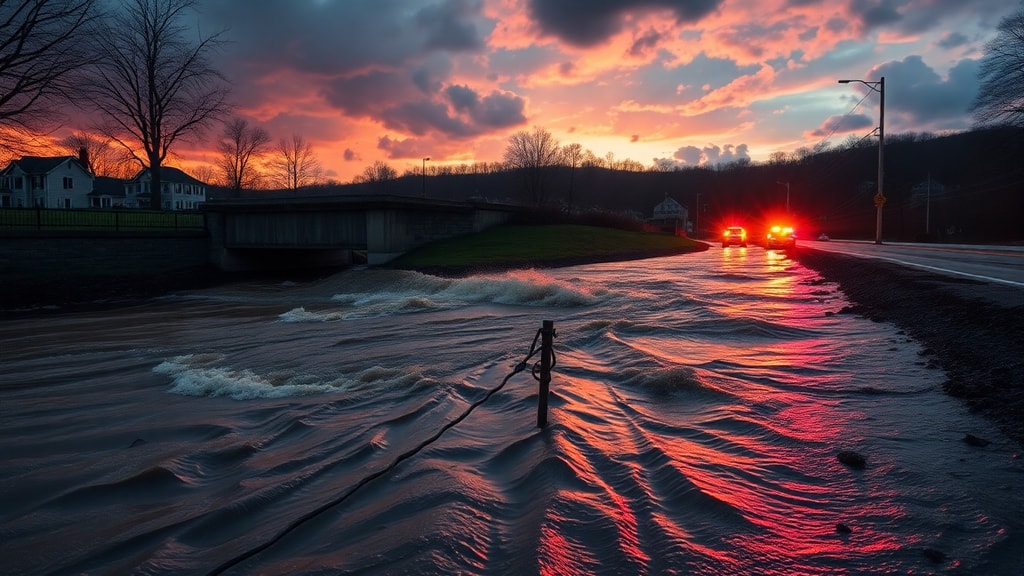
This topic is trending right now because recent rounds of severe weather across the eastern United States have repeatedly produced rainfall bursts capable of triggering flash floods—particularly when storm systems stall or repeatedly pass through the same corridor. In the Kentucky context, the catalyst typically takes a recognizable form: a period of unsettled conditions, followed by thunderstorms with high rainfall rates, followed by rapid cresting in local waterways. The public attention intensifies when these events coincide with visible, immediate impacts—road closures, damaged vehicles and homes, emergency rescues, and viral images of swollen creeks.
In recent cycles, social media and local news ecosystems have amplified the speed at which information spreads. Residents share real-time footage of water overtopping roads and overflowing ditches; nearby counties monitor whether rain bands are moving toward their area; and emergency managers update advisories as conditions evolve. That information velocity can be lifesaving—but it also reveals the hard truth: flash flooding can overwhelm “normal” expectations for timing. People are accustomed to thinking in hours, not minutes, and they may not fully connect heavy rain in one location to sudden flooding downstream within minutes.
The other driver of attention is the broader climate-and-weather narrative entering everyday life. When multiple flash-flood events occur in close succession—across multiple states—public concern shifts from isolated incidents to a pattern. For Kentuckians, the question becomes less “Will it flood?” and more “How often, how fast, and how prepared are we when it does?”
Deep Dive
A quick history: why flash floods are not new
Flash floods are not a modern invention. Kentucky has long experienced episodes of intense rainfall and rapid water rise. What has changed is the frequency of extreme rainfall periods in many regions, alongside how people have built, expanded, and depended on road networks that are vulnerable to rapid overtopping and debris clogging.
Historically, communities addressed flooding with a mix of land-use planning (sometimes imperfect), infrastructure upgrades, and local knowledge—knowing which roads become impassable, which creeks rise quickest, and which neighborhoods act as “channels” for runoff. That knowledge was valuable, but it was often localized. A resident might understand their own street’s risk, while underestimating how rainfall in neighboring drainage areas could force water downstream. This mismatch—between local intuition and watershed reality—has always been a challenge, but it becomes more severe when weather systems intensify.
The second-order dynamics: water doesn’t only come from the sky
Flash flooding is often explained as “heavy rain,” but the true risk chain is more layered.
1. **Antecedent soil moisture:** If the ground is already saturated from prior storms, the same rainfall produces dramatically higher runoff. In practical terms, water that would have soaked into soil instead becomes overland flow, racing toward low points.
2. **Basin shape and slope:** Kentucky’s terrain can shorten the time between rainfall and runoff concentration. Steeper slopes mean faster response times—less time for warnings to translate into action.
3. **Small-stream behavior:** Many flash floods in Kentucky are driven by creeks and tributaries that drain relatively small areas. These watersheds can respond so quickly that river gauge data from larger rivers may not reflect what’s happening locally.
4. **Debris and blockage:** Even modest flooding can become catastrophic when culverts or bridge openings are clogged by leaves, branches, trash, and sediment. Blockages divert water sideways—into yards, underpasses, and streets—creating secondary damage.
5. **Infrastructure vulnerability:** Stormwater systems and culverts are designed with certain return periods in mind. When rainfall intensity rises beyond those assumptions, systems “fail gracefully” at first—then abruptly. The transition is critical: roads that look passable can become hazardous in minutes.
Analytical lens: warnings versus reality
Emergency alerts are built on forecasts and hydrologic models, but flash flooding sits at the boundary between prediction and suddenness. Models may indicate a high probability, yet the lived experience is that conditions can change faster than people can process. A warning that arrives at the right time is not enough if residents are still driving, still working, or still assuming “it’s probably fine.”
This is where communications strategy becomes as important as meteorology. The most effective messaging tells people what action to take immediately: avoid crossing moving water, move to higher ground, and do not assume roads will remain passable. In Kentucky, where rural routes are common and cell reception can be inconsistent in some valleys, redundancy matters—sirens, community networks, and clear guidance from local authorities.
What it means for public safety and economic stability
Second-order implications extend beyond the immediate emergency.
In a state where livelihoods can depend on access—farms, service businesses, small manufacturers—flash flooding becomes a macroeconomic issue as much as a meteorological one.
Future Outlook
As a trend journalist watching how public systems evolve, my forward-looking prediction is this: Kentucky will increasingly treat flash flooding as a continuous planning domain rather than a rare disaster category. The likely trajectory includes three shifts.
First, **real-time monitoring will become more local and more granular**—more watershed-level sensors, better radar-informed hydrology, and improved integration with roadway and culvert risk mapping. The goal will be to reduce the gap between “a warning was issued” and “the hazard was visible where I am.”
Second, **infrastructure resilience will move from reactive repairs to proactive retrofits.** Expect more culvert resizing, debris management strategies, bridge-clearance assessments, and stormwater upgrades, particularly in known bottleneck areas. These investments will be framed not just as disaster spending, but as routine modernization of transportation and drainage.
Third, **community preparedness will shift toward behavioral engineering.** Emergency management will likely expand pre-storm education, emphasize non-negotiable rules (do not drive through moving water; seek higher ground early), and leverage trusted local channels rather than relying solely on broad alerts.
If this happens—if Kentucky marries better detection with smarter infrastructure and clearer action—flash flooding will remain dangerous, but it will become less surprise-driven and less catastrophic in outcome. The weather will still be the trigger, but the resilience will be the differentiator.