GMA Deals and Steals: How a Morning-Show Commerce Model Became a National Shopping Habit
Published: June 26, 2026
Introduction: What “GMA Deals and Steals” Is—In Detail
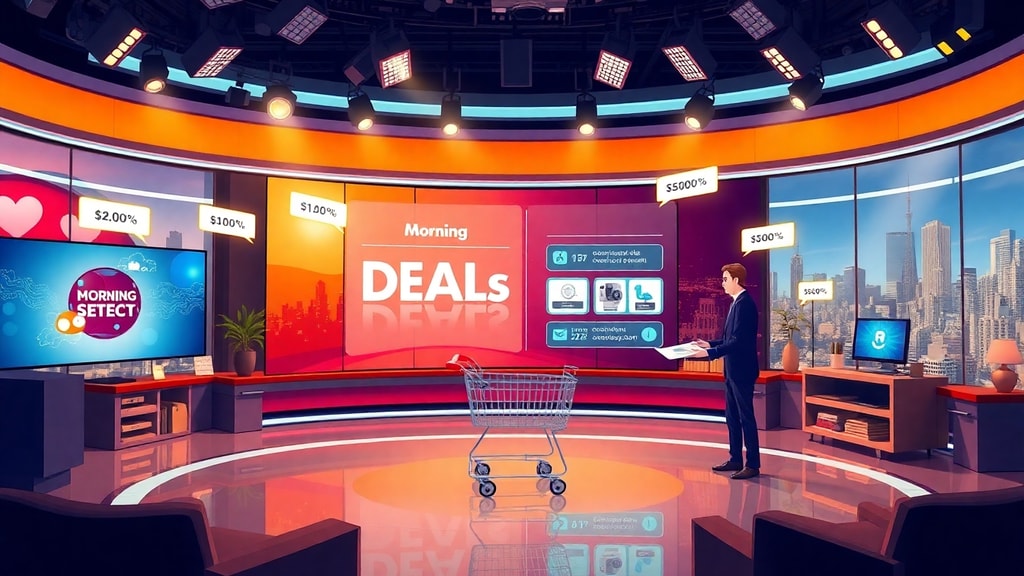
“GMA Deals and Steals” is a recurring, retail-focused segment within **Good Morning America (GMA)**—a long-running U.S. morning television show produced by ABC. The show’s format is designed for mass daily viewing, but this specific segment targets a different audience need: **turning viewers’ everyday purchase intent into fast, broadcast-driven discovery of discounts and limited-time offers**.
In practical terms, “GMA Deals and Steals” presents products across categories such as home goods, personal care, tech accessories, kitchen tools, travel items, fitness gear, and seasonal must-haves. The segment typically highlights products at promotional prices, framed as “deals” (usually a discount off a regular price) and “steals” (often emphasizing an unexpectedly low price or a value claim relative to typical retail costs).
What distinguishes the segment from generic coupon content is the **combination of editorial framing and urgency mechanics**. Viewers aren’t merely told “this item is on sale.” They’re presented with:
It’s also worth clarifying the distribution system. “GMA” is a television brand, but “GMA Deals and Steals” behaves like a modern commerce channel. The segment is echoed and extended online through clip distribution, product pages, social amplification, email/notification strategies, and retargeting. In effect, it functions as a **cross-platform retail discovery engine**: TV introduces; digital channels capture; the checkout happens elsewhere.
As a trend journalist, I see it as a hybrid: part consumer media, part retail media network, and part performance marketing funnel—delivered with morning-show reach.
The Catalyst: Why This Format Is Trending Right Now
“GMA Deals and Steals” is trending right now for a simple reason: **the public has developed a renewed appetite for value—at the same time brands need measurable results**.
Over the last couple of years, consumer behavior has shifted in ways that directly benefit deal-led entertainment:
1. **Inflationary memory and budget triage.** Many households still treat discretionary spending as something to justify. Viewers increasingly look for “proof of value” rather than wishful brand loyalty.
2. **The rise of video-first commerce.** Short-form and livestream shopping have normalized the idea that buying can happen while watching. Even when customers don’t buy instantly, they increasingly research products in the same session.
3. **Retail media networks and attribution pressure.** Brands and retailers are under pressure to show that marketing spend converts. A segment that pairs storytelling with product links and time-bound promotions offers clearer measurement than traditional ads.
4. **More consumer trust in “curated” recommendations.** When customers feel overwhelmed by choice, curation becomes a commodity. A trusted mainstream brand like ABC’s GMA can act as an authority layer.
Finally, there’s the immediate cultural trigger: the public conversation around “deal hunting” has become evergreen content. Viral clips, social posts featuring branded products, and the online search behavior that follows a broadcast segment create a predictable loop: **watch → clip → click → compare → buy**. When that loop repeats daily or weekly, the segment becomes a routine—turning a one-off discount into an ongoing shopping identity.
Deep Dive: The Historical Roots and Second-Order Implications
To understand “GMA Deals and Steals,” you have to place it in the longer history of American consumer media.
From Infomercials to Editorial Commerce
Television has always sold ideas and objects. But the “deal segment” is a modern evolution of earlier formats:
What’s different today is the integration of **editorial storytelling** with **trackable commerce**. Traditional TV could move product awareness; it struggled to prove conversion at scale. Modern platforms close that gap by attaching links, pixels, promotional codes, and analytics.
The Mechanism: Why Broadcast Deals Work
The segment’s success is not just about discounts—it’s about how attention is guided.
1. **Authority + familiarity.** GMA is a daily habit for millions, which means viewers already “know the channel’s voice.” That lowers the perceived risk of buying something featured on-air.
2. **Recommendation compression.** Instead of requiring consumers to navigate endless reviews, the segment compresses decision-making into a brief, persuasive narrative.
3. **Scarcity and timing.** Deals become emotionally urgent when framed as limited-time opportunities. This doesn’t just trigger impulse; it converts indecision into action.
4. **Social proof through replication.** Once a deal is featured, it often generates copycat coverage—viewers discuss it, post about it, and search for it. That replication increases brand salience.
Second-Order Implications: What This Means for the Retail Economy
The deeper impact isn’t the immediate purchase; it’s what this format does to the market structure.
**First-order effect:** Consumers benefit from curated discounts and clearer product discovery.
**Second-order effect:** Retailers and brands may restructure budgets toward formats that provide both storytelling and measurable outcomes. If a morning-show deal segment can generate trackable sales, it competes directly with paid search, influencer posts, and social ads.
**Third-order effect:** Product lifecycles may accelerate. When attention becomes more episodic (“the deal is live right now”), brands are incentivized to create more promotional inventory windows. That can strengthen competition for visibility but also intensify price volatility.
There is also a cultural effect: shopping becomes less solitary. Deal discovery is social again—less like combing through an app alone, more like reacting to a shared news moment.
The Quality Question: Are Deals Truly “Steals”?
A responsible trend analysis must also ask: how often do these featured products justify the value claim? The truth is that “deal” framing can be accurate—but value is a spectrum.
Viewers should treat deal segments as **starting points**, not final evaluations. A good product at the right price matters, but so do fit-for-purpose considerations: compatibility, durability, warranty terms, shipping realities, and user requirements.
The segment’s journalistic challenge is to keep curation rigorous. When audiences trust a format, they can become more vulnerable to hype. The best iterations of “GMA Deals and Steals” maintain credibility by emphasizing practical utility and by ensuring that discounted items are not merely novelty—but legitimately useful.
Future Outlook: Bob’s Prediction for Where “GMA Deals and Steals” Goes Next
Here’s my forward-looking prediction: **“GMA Deals and Steals” will evolve into a more interactive, multi-channel retail newsroom—where deals are tied to dynamic content, audience preferences, and near-real-time inventory signals.**
Instead of functioning solely as a broadcast segment with a static online echo, it will likely incorporate:
In plain terms: the next phase is not just “deals on television.” It’s **commerce as media that behaves like a live system**—responsive to consumer behavior, brand inventories, and platform dynamics.
If that sounds like a natural progression, it’s because it is. Morning shows are built on routine and trust; commerce is built on conversion and urgency. “GMA Deals and Steals” sits at their intersection—and once a hybrid model proves it can move both attention and transactions, the industry tends to replicate it.
My expectation is that viewers will increasingly treat “GMA Deals and Steals” as a weekly or daily ritual—one that feels less like shopping and more like receiving trustworthy guidance in a noisy marketplace.