Grand Junction: The Western Slope’s Strategic Pivot Point for Climate Resilience, Water Tech, and Regional Growth
Published: June 21, 2026
1) Introduction: What “Grand Junction” is—and why it matters
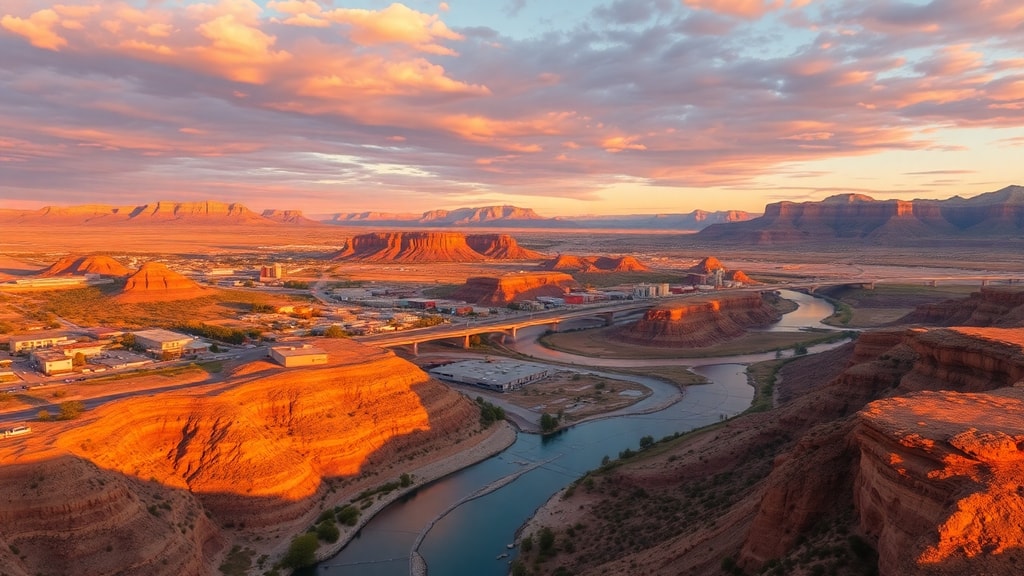
“Grand Junction” is the name of a city in western Colorado, seated at the confluence of major transportation corridors and—more importantly for its identity—within the Colorado River Basin. It is not a generic mountain town. It is a regional hub whose geography places it at the intersection of irrigation history, energy and logistics networks, and the practical challenges of semi-arid climate.
Grand Junction serves as a center for the Western Slope, supporting regional healthcare, education, government services, retail, and access to the recreational and natural economy tied to nearby public lands. Its urban form, like much of the American West, reflects a long relationship with water engineering: canals, diversion works, and municipal planning built around the seasonal variability of snowmelt and runoff. The city is also closely tied to the river’s ecological health and to the economics of agriculture and tourism that depend on predictable water delivery.
Economically, Grand Junction is known for diversification—energy-adjacent industries, manufacturing and construction, health and wellness services, and a growing tourism and outdoor recreation sector. But the most defining feature of its contemporary relevance is its exposure to systemic risks: drought cycles, wildfire smoke, heat extremes, and water scarcity pressures that extend well beyond city boundaries. These pressures don’t remain abstract. They show up in infrastructure budgets, housing decisions, water rights negotiations, and public health planning.
In short, Grand Junction is a real-world laboratory of how an inland city navigates climate constraints while trying to remain attractive for residents, businesses, and travelers. It’s the kind of place where long-term decisions are forced to become short-term actions.
2) The Catalyst: Why the topic is trending right now
Grand Junction is trending because the underlying drivers—water scarcity, resilience funding, and infrastructure modernization—have moved from long-range planning into urgent implementation.
Three converging triggers are at play.
First, recent years have intensified public and political attention on drought and water management across the Colorado River Basin. Even when headlines focus on water allocations at the basin scale, the consequences land locally: municipal conservation measures, changes in agricultural delivery, and the need for modernization of systems that were designed for different hydrological assumptions.
Second, wildfire season and heat extremes have made “resilience” a measurable category rather than a slogan. For a city embedded in a high-impact environment—near interface zones and with air-quality impacts—emergency planning, vegetation management, building codes, and grid hardening are increasingly visible community issues.
Third, regional development pressures have accelerated. Housing demand in many Western cities has been uneven, but Grand Junction’s role as a logistics and access point for surrounding communities keeps drawing investment attention. When growth meets water limits, it forces policy and technology decisions to the front page.
Put together, the story is simple: Grand Junction is experiencing the same climate stressors seen across the West, but its basin position and infrastructure needs make those stressors harder to ignore.
3) Deep Dive: History, analytical context, and second-order implications
To understand Grand Junction’s current pivot, it helps to view the city as a node in a water-and-infrastructure system rather than as an isolated municipality.
A historical baseline: water shaped the city’s logic
Grand Junction’s founding and expansion were inseparable from the promise of irrigated agriculture and the practicalities of settlement in semi-arid terrain. Historically, water management relied on a mix of diversion, storage, canal distribution, and institutional rules for allocation. These systems were engineered around patterns of snowpack and runoff that—while variable—were predictable enough for long planning horizons.
But the American West’s climate reality has shifted toward more frequent extremes. Snowpack timing, melt intensity, and the probability of low-water years have changed the actuarial assumptions behind water operations. That’s not merely an environmental story; it’s a governance story.
The second-order implication: water scarcity becomes an economic multiplier
When water constraints intensify, the effects do not stop at agriculture. Municipal water planning influences industrial siting decisions, construction schedules, and public health outcomes.
In Grand Junction’s case, second-order effects show up as:
The result is that water management becomes a proxy for future competitiveness.
The “resilience stack”: more than emergency response
Resilience in Grand Junction cannot be limited to firefighting or storm response. It requires a stack of interconnected capabilities:
1. **Physical resilience**: hardened utility infrastructure, flood-aware planning, and building standards tailored to heat and smoke exposure.
2. **Operational resilience**: emergency communications, public health protocols, and continuity planning for water and power services.
3. **Community resilience**: education, neighborhood-level cooling and air filtration resources, and trust in local institutions.
This is where cities like Grand Junction diverge from purely scenic destinations. The city’s outdoor appeal is real, but maintaining it under climate pressure demands maintenance of the invisible systems that keep people safe.
Technology and governance: the new toolkit
Grand Junction’s forward movement is best understood as a shift in toolkit—from large, one-time engineering wins toward continual optimization.
That includes:
The second-order implication is that the city becomes more than a beneficiary of grants or policies—it becomes an implementer with a learning curve, generating data, procedures, and institutional capacity that can be reused across other Western communities.
Why Grand Junction’s geography amplifies its significance
Being in the Western Slope means travel corridors connect it to larger markets, but also means it is exposed to the basin’s hydrological realities. Unlike coastal areas where ocean buffering can moderate certain risks, inland basins concentrate variability. For Grand Junction, that translates into a governance imperative: adapt faster, measure better, and plan across longer horizons.
In trend terms, Grand Junction is less about a single viral event and more about the way its lived conditions mirror the West’s hard constraints—making it a frequent reference point for policymakers, engineers, and analysts.
4) Future Outlook: Bob’s prediction for what comes next
I expect Grand Junction to evolve into a more explicit “resilience-and-water operations” leader among Colorado’s Western cities—less known for one breakthrough, more defined by consistent execution.
My forecast is threefold:
1. **Water management will become a competitive advantage** rather than a compliance burden. Cities that can reliably manage demand, reduce losses, and improve reuse will attract businesses and residents who value stability.
2. **Infrastructure investment will shift toward continuous optimization**—monitoring, automation, and adaptive planning—because static plans will be repeatedly challenged by hydrological uncertainty.
3. **The city’s growth narrative will increasingly hinge on climate readiness**. Housing, public health resources, and emergency preparedness will be treated as economic infrastructure.
In the near future, Grand Junction won’t just “respond” to climate stress. It will institutionalize the ability to respond—building a playbook that other inland regions will study. And that is why “grand junction” is trending: not because the story is comfortable, but because it is becoming instructive.