Green Boots: How a Color Trend Became a Signal for Sustainability, Identity, and Design Innovation
Published: August 10, 2026
Introduction
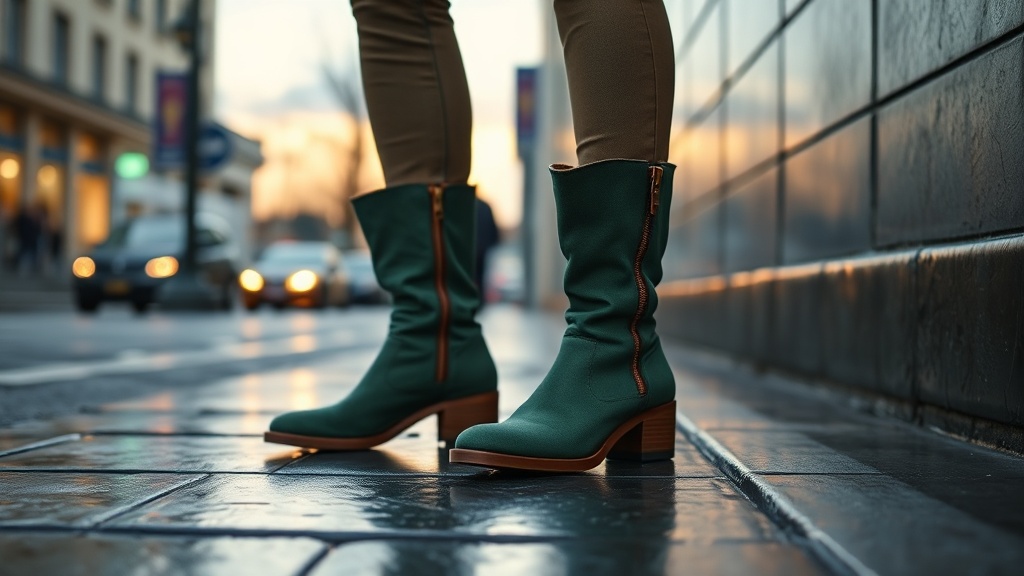
Green boots are exactly what they sound like: footwear—typically ankle, mid-calf, or knee-high—whose dominant color is green. In contemporary fashion discourse, “green boots” rarely refer to a single shade or style. They can mean deep forest or emerald leather, matte suede boots, tactical-looking rubber or EVA designs, hiking-inspired models, and even high-fashion silhouettes rendered in kelly green or moss tones.
To understand why green boots matter, it helps to define what they represent in modern wardrobes. Boots are not casual accessories; they are structural garments. They shape posture, define silhouette, and serve as a practical “anchor” for an outfit—especially in transitional seasons when weather is variable. When that functional item is dyed or engineered in a distinctive color, it becomes a statement object: something you notice from across the street.
In today’s market, green boots sit at the intersection of three powerful forces:
1) **Visual identity**: Consumers use color to communicate taste, mood, and belonging. Green, in particular, signals nature, renewal, calm, and sometimes political or environmental awareness.
2) **Material choice and performance**: Boots increasingly reflect advancements in dyes, coatings, and new recycled or bio-based materials.
3) **Design narratives**: Brands are marketing “story” around products—origin of materials, repairability, durability, and craft.
That triad—identity, material innovation, and narrative marketing—helps explain why green boots have become more than “just another colorway.”
The Catalyst
Green boots are trending right now because several converging triggers have recently made them visible, repeatable, and aspirational.
First, **short-form video platforms and outfit-first styling accounts** have amplified “color blocking” and “statement boots” content. Algorithms reward distinct visuals, and green—especially when paired with neutrals like beige, charcoal, cream, and denim—creates a high-contrast look that performs well on camera.
Second, **mainstream brands have rolled out capsule collections** featuring natural palettes, including greens that echo outdoor gear and heritage workwear. This is not limited to niche labels; major retailers have increasingly favored earthy color stories across footwear lines.
Third, there has been a renewed public focus on **sustainability language**—not always perfectly executed, but clearly influential. When consumers encounter brands discussing recycled rubber, responsibly sourced leather, lower-impact dye processes, and longer product life, buyers become more interested in “wearable proof” rather than abstract claims. Boots are a natural choice for that proof: they wear longer, get noticed more, and often last multiple seasons.
Finally, social culture has shifted toward **“quiet utility”**—the idea that everyday items should look practical while still expressing personality. Green boots, with their ability to read as both outdoorsy and urban, fit that logic precisely.
Deep Dive
To analyze green boots properly, we need to zoom out. Color trends do not emerge from nowhere; they are social signals shaped by technology, economics, and taste cycles.
A brief history of the “green” in footwear
Green has long been present in footwear, especially in workwear contexts where durability and camouflage logic mattered. Shades like deep green and moss tones appeared in uniforms, hunting boots, and industrial styles because they hid scuffs and dirt. But fashion also adopted green periodically:
What’s changed in the current era is not the existence of green—it’s the sophistication of production and the intensity of consumer storytelling.
Why boots, not just shoes?
Boots create a stronger brand effect because they dominate vertical space on the body. From a marketing perspective, that matters. In a crowded feed, boots are legible at a glance. In a wardrobe, they are “base equipment” for multiple looks: jeans, skirts, outerwear, and even tailored trousers.
Green boots therefore become a kind of wardrobe infrastructure. They let people build outfits around one confident decision while keeping everything else neutral. This reduces cognitive load for consumers who feel overwhelmed by fast fashion’s endless options.
The materials and the second-order implications
Green boots often appear alongside claims about better materials—recycled content, bio-based components, or improved dye processes. Even when these claims are exaggerated, the broader industry pattern is real: footwear brands are under pressure to reduce waste, lower emissions, and improve traceability.
Here are the second-order implications—what happens after people start buying green boots:
1) **Color sustainability scrutiny rises**
Green is not automatically “eco-friendly.” Dyes and pigments vary widely in environmental impact. As green becomes trendy, consumers demand transparency: what pigment was used, how wastewater was treated, and whether the color holds up without excessive re-dyeing.
2) **Repair and longevity narratives gain traction**
Boots invite talk of resoling, cleaning, and maintenance. When buyers invest in a standout color, they tend to care more about preservation. That can strengthen brands that offer repair services or parts, creating a reputational incentive for durability.
3) **Design systems shift toward versatility**
To justify higher prices and longer wear cycles, brands increasingly design boots that match multiple wardrobes. Green becomes a “bridge color” between outdoor gear and city styling, nudging product design toward modularity—swap liners, compatible insoles, adaptable soles.
4) **The aesthetic of “nature” becomes more urban**
Second-order cultural effects matter: as green boots move from trails into streets, the idea of nature stops being remote. It becomes a lifestyle interface—something worn. That can influence how consumers interpret other categories too: bags, outerwear, and even smartphone accessories.
Analytical voice: what green boots reveal about the market
The green boots trend is, at its core, a story about *where attention is going*. It shows that consumers are not just buying items; they are buying meanings that feel coherent.
Green boots also demonstrate that footwear is increasingly a platform for experimentation. Color is the cheapest form of novelty, but it’s also one of the most emotionally charged. It lets brands iterate quickly while still offering a “premium” perception, especially when the shade is distinctive—like deep forest or muted sage—rather than generic neon green.
Future Outlook
If current signals hold, green boots will likely evolve from trend-season purchases into semi-permanent wardrobe staples.
My prediction is that **two developments will accelerate**:
1) **Better materials and clearer sustainability proof** will become a differentiator. Brands that can substantiate dye impact, recycled content percentages, and repair options will capture repeat buyers.
2) **Color families will diversify**. Instead of a single green “moment,” we will see a spectrum—sage, olive, moss, and evergreen—each paired with distinct textures (suede, leather grain, rubber matte) and functional technologies (traction, insulation, comfort midsoles).
By next year, the most influential green boots will be those that feel consistent: not merely fashionable, but reliable—comfortable enough for commuting, sturdy enough for weather, and visually distinctive enough to anchor a look. In other words, the trend will mature from “buy the color” into “buy the philosophy.”
And once that transition happens, green boots won’t be a fleeting headline—they’ll become part of the standard vocabulary of modern style.