Jonathan Hickman: The Architect of Modern Narrative Systems
Published: August 11, 2026
1) Introduction
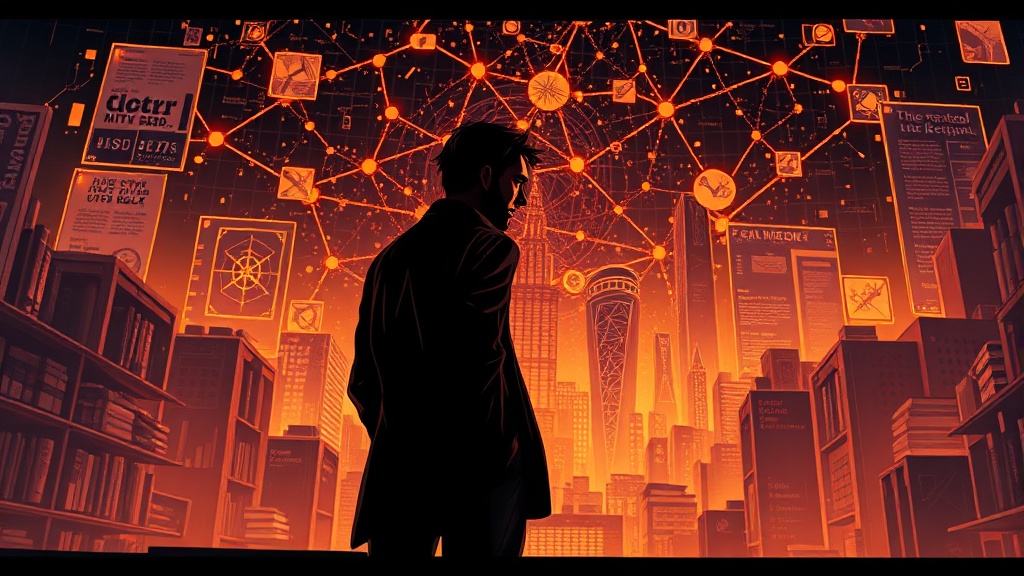
Jonathan Hickman is a contemporary comics writer celebrated for treating storytelling like architecture—building structures where themes, characters, and plot mechanics reinforce one another across long arcs. Unlike writers who prioritize scene-level spontaneity, Hickman is widely recognized for engineering narrative systems: he lays down premises with near-scientific clarity, then designs plot “rules” that characters must obey. In practice, this means his books often feel like living models of politics, philosophy, science, and power—models that evolve under pressure.
Hickman’s prominence is inseparable from the way he reshaped large-scale genre storytelling within mainstream comic publishing. He gained major visibility through creator-forward work such as **"The Manhattan Projects"**, where historical figures and scientific institutions are reframed inside a surreal, alternate framework of conspiratorial causality. He then became a household name among comic readers—especially those who follow event-era publishing—through his work on major continuity properties, including **"Fantastic Four"**, **"East of West"**-adjacent readership overlap through his tonal range, and especially his long-running, interlocking contributions to Marvel’s flagship titles. His **"Fantastic Four"** run is often described as a manifesto of cosmic stakes and institutional transformation, while his **"Avengers"** era is frequently cited for how it turns world politics into plot geometry.
Importantly, Hickman isn’t merely a “big ideas” writer. His craft is defined by *constraints*: he sets narrative parameters—time, agency, institutional roles, moral accounting—then uses them to produce credible consequences. Readers are not only entertained; they are invited to track logic, anticipate moves, and experience the payoff of a carefully designed sequence. Even when his stories contain grand speculative leaps, they tend to return to a core Hickman question: **who gets to define reality, and by what institutional mechanism?**
That question helps explain why the term “Hickman-style” has become a recognizable shorthand in fandom. It describes the fusion of high-concept premises, dense plotting, and a sense that the story is preparing a downstream machine rather than delivering a single dramatic moment. For many creators and readers, Hickman represents a particular modern mainstream ideal: *serialization as systems design*.
2) The Catalyst
Hickman is trending right now for a straightforward, observable reason: **readers are rediscovering the coherence of his multi-series storytelling model at the same moment the comics industry—and its audience—are hungry for long-form narrative payoff.** In the last year, conversation spikes commonly coincide with three converging triggers: renewed visibility of his earlier runs through digital storefront emphasis, the ongoing cultural algorithm that amplifies “architectural” media recommendations, and fresh marketing/reader attention cycles around flagship event logic.
What makes this moment distinctive is that Hickman’s strengths align with a new wave of audience behavior. Modern readers consume in bursts—following recommendations, reviewing summaries, and then returning for rereads. Hickman’s work rewards precisely this pattern because his stories are structured for recursion: rereading often reveals that earlier details were not filler but components of a larger machine. When social platforms circulate threads about “what people missed the first time,” Hickman’s bibliography becomes a ready archive.
Additionally, in mainstream comics, recent discourse has emphasized authorial intent, world-building depth, and the legitimacy of “plot mechanics” as a craft. Hickman’s reputation provides a convenient anchor: he is widely cited as a writer who makes the invisible labor of continuity and consequence feel inevitable. When the industry leans toward clarity and cohesion—or when it struggles with fragmented event fatigue—audiences look for creators whose work demonstrates that big stakes can still be internally consistent.
So the catalyst is not only one headline. It is the convergence of **platform-driven reread culture**, **renewed event-era discussion**, and **a market craving for narrative engineering**—all of which make Jonathan Hickman’s “systems” approach feel newly relevant.
3) Deep Dive
To understand Jonathan Hickman’s impact, it helps to treat his career as an evolution of *method*, not just style.
Historical context: from prestige hooks to structural payoff
The modern comics boom of the 1990s and 2000s produced two prominent storytelling attitudes. The first treated comics as an outlet for improvisational character drama; the second treated comics as a canvas for creators to craft prestige worlds with cinematic premises. Hickman’s work belongs to both attitudes, but he also corrects a problem inherent to each.
Improvisational drama can sometimes dissolve into mood—emotion without mechanism. World-building can become spectacle—lore without consequence. Hickman’s distinctive contribution is that he does both *with feedback loops*: the mood matters because institutions and power dynamics produce it, and the lore matters because it changes what characters can do next.
His plots often resemble strategic games. That analogy is not just metaphor. Hickman frequently organizes stories around information control: who knows what, when they know it, and how knowledge changes bargaining power. In his best work, revelation is not merely a twist; it is a move that reconfigures the board.
The Hickman “system”: premise, rule, escalation, accounting
A simplified way to describe the Hickman system is: **premise → rule → escalation → accounting.**
1. **Premise:** A bold conceptual question is introduced early, often tied to institutions—science, religion, bureaucracy, military logic, or corporate power.
2. **Rule:** Hickman then establishes narrative rules. The universe’s laws—social and causal—are made legible enough that readers can track their violation.
3. **Escalation:** Events do not simply increase in intensity; they increase in *structural pressure*. Characters get fewer safe options because the system they operate within tightens.
4. **Accounting:** The story “pays” for its earlier assumptions. Choices echo. Cost is measured.
This is why his work feels “dense” but also why it often feels “fair.” Readers may be overwhelmed, but the overwhelm is usually intentional: Hickman wants you to understand that the stakes aren’t just emotional—they are systemic.
Second-order implications: what his approach changes
The second-order implications of Hickman’s storytelling extend beyond any single franchise.
**First, he raises reader expectations for narrative continuity as a craft.** In a marketplace sometimes criticized for episodic churn, Hickman demonstrates that continuity can be more than background detail. It can be the engine of surprise.
**Second, he contributes to an emerging creator philosophy: plot is not the enemy of character—it is one of the ways characters reveal themselves.** Characters in Hickman’s work often look like operators under stress. Their personalities emerge through how they respond to constraints.
**Third, he strengthens the case for comics as serious narrative technology.** In discussions about transmedia—adaptations to screen, games, and serialized audio—Hickman’s work frequently gets referenced as proof that comics can sustain complex logic that would translate well into interactive or serial digital formats.
**Finally, he influences how fandom studies stories.** Fans increasingly act like analysts: tracking motifs, mapping character incentives, and comparing structural arcs across series. Hickman’s books are ideal for this behavior because they are designed with recognizable architectural gestures.
Critiques and the cost of complexity
No architect is free of criticism. Hickman’s complexity can alienate readers who prefer immediacy or character intimacy without heavy plot engineering. The density can also create a perception that emotion is secondary to concept.
Yet even this critique often functions as evidence of his method. Hickman uses concept as an emotional instrument: if power is institutional, then heartbreak can be produced by systems rather than by purely personal failings. For some readers, that is alienating; for others, it is the point. Either way, the debate itself is part of his cultural footprint.
4) Future Outlook
My forward-looking prediction is that Jonathan Hickman will increasingly function as a *narrative template* rather than only a singular author—one that publishers and creators emulate when they want serialization to feel inevitable.
The reason is structural: the modern attention economy is volatile, and readers are drawn toward work that offers both spectacle and coherence. As digital consumption normalizes rereads, summary culture, and algorithmic recommendations, narratives that reward second or third passes become safer investments. Hickman’s method already sits at that intersection.
In the near future, I expect two outcomes.
**First:** more creators will adopt Hickman-like “systems design” approaches—plot mechanics that make the world’s politics legible, and long arcs that pay off with structural accounting rather than only thematic echoes.
**Second:** mainstream publishing will likely treat inter-series logic as a more intentional product feature. When audiences ask, “Is this universe building leading somewhere?”, Hickman’s catalog provides a proof-of-concept that event-scale complexity can still feel authored.
Jonathan Hickman is not merely trending because his ideas are large. He is trending because his stories model a discipline that the medium is relearning: that imagination works best when it is engineered to endure.