Seismic Waves Explained: How Earthquakes Send Signals Through Our Planet—and Why Everyone Is Paying Attention Now
Published: June 24, 2026
1) Introduction: What seismic waves are, and what they reveal about Earth
A **seismic wave** is any wave of energy that propagates through the Earth (and sometimes along Earth’s surface or through the atmosphere) after it’s generated by an event—most notably an **earthquake**, but also volcanic activity, large landslides, or even human-made sources such as explosions and controlled tests. In plain terms: when the ground suddenly slips, fractures, or shifts, the stored elastic energy doesn’t just disappear. It **radiates outward** as vibrations, like ripples expanding from a stone dropped into water, except the medium is not water—it is Earth’s complex interior.
To understand seismic waves, picture Earth as a layered system of solids with varying density, stiffness, and composition. When energy travels through such a system, it can do so in different ways depending on how the material is forced to move. Seismology—one of the most data-driven branches of geophysics—studies those waves to infer what Earth is like at depths we cannot directly observe.
Seismic waves are commonly grouped into two major families:
1. **Body waves**, which travel through Earth’s interior.
2. **Surface waves**, which travel along the Earth’s exterior interface and often cause the strongest shaking during large earthquakes.
Within body waves, the most fundamental division is between **P-waves (primary waves)** and **S-waves (secondary waves)**:
Surface waves include **Love waves** and **Rayleigh waves**, which spread along the surface and produce rolling or side-to-side motion that is often more destructive for buildings and critical infrastructure.
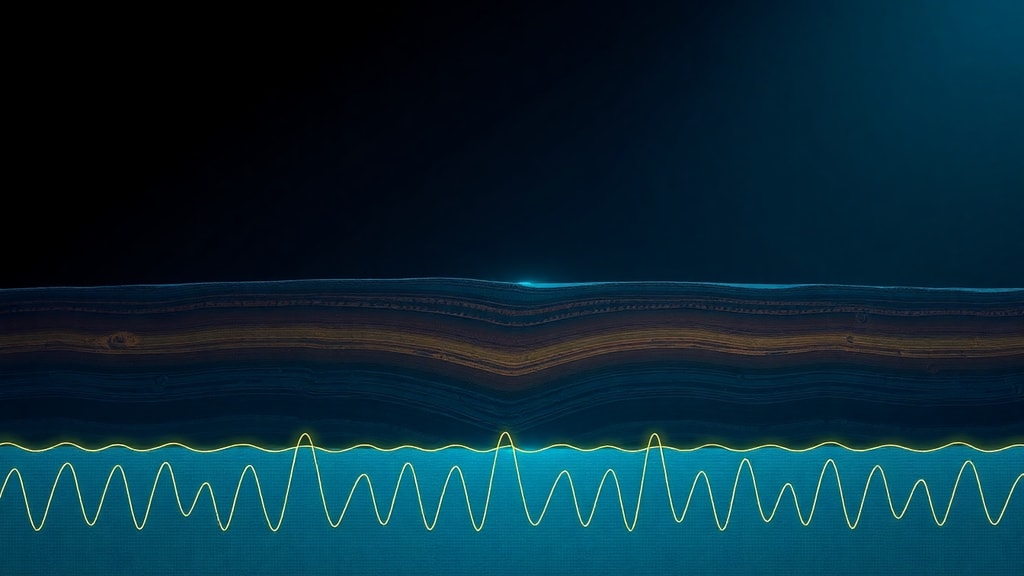
A seismogram—recordings from instruments called **seismometers** or **accelerometers**—captures the time history of ground motion at a particular location. From that record, seismologists can estimate earthquake timing, magnitude, and location, and—critically—interpret the structure of Earth along the paths the waves traveled.
2) The Catalyst: Why seismic waves are trending right now
Seismic waves are trending not because the physics suddenly changed, but because **the systems that detect, share, and interpret seismic signals are accelerating**. The trigger is the recent convergence of three developments:
1. **Wider deployment and modernization of seismic networks**—including dense arrays, improved sensors, and faster telemetry—making near-real-time wave detection increasingly common.
2. **Public alert ecosystems** that transform raw wave arrivals into actionable warnings (for example, alerting systems that use early-arriving P-waves to estimate shaking from later, more damaging phases).
3. **Cross-border data integration and heightened attention to disaster resilience**, spurred by major recent earthquakes globally, where communities and governments have demanded faster situational awareness.
In effect, the same seismic waves that scientists have studied for a century are now being operationalized at scale. When an earthquake happens, society increasingly wants immediate answers: *Where is it? How strong is it? What will arrive next and how soon?* Seismic waves are the underlying “language” that answers those questions.
3) Deep Dive: History, analytical context, and second-order implications
Seismology’s story is a story of waves turned into knowledge. Early researchers recognized that earthquakes generate different “types” of motion and that arrival times contain information. The decisive leap came when seismologists realized they could treat Earth as a physics problem: waves travel through layered media, and each phase carries clues about velocity structure.
The analytical backbone: travel time, attenuation, and waveform shape
Seismic wave analysis typically relies on three pillars:
These principles underpin earthquake localization and magnitude estimation. But they also extend into deeper research: **tomography**, the technique of reconstructing three-dimensional Earth structure from many wave paths, has become an indispensable tool. Earth’s crust and mantle are not uniform; they contain faults, volcanic plumbing, sedimentary basins, and varying rock types. Seismic waves illuminate that architecture.
Historical background: from landmark theories to modern computational inversion
The early 20th century era of seismology established the P/S framework and connected wave behavior to Earth’s internal properties. The famous inference that the outer core is liquid emerged because S-waves do not pass through it. That simple rule—S-waves are blocked by fluids—was extraordinarily powerful.
Modern seismology has moved far beyond that. Today’s approaches combine high-quality data with sophisticated computational inversion and machine-learning-assisted workflows to improve speed and accuracy. Researchers do not merely catalog wave arrivals; they fit entire waveforms, interpret frequency-dependent behavior, and use large seismic datasets to detect subtle changes.
Second-order implications: more than earthquakes—societal safety and global monitoring
The significance of seismic waves now extends into several second-order domains:
1. **Risk mitigation becomes wave-informed.** Engineering design depends on expected ground motion. Seismic wave characteristics—frequency content, duration, and amplitude—feed directly into how engineers model shaking hazards.
2. **Early warning is a wave-timing strategy.** Systems that trigger alerts often rely on the fact that P-waves arrive before stronger S-wave-driven shaking. That changes disaster response from “after-the-fact” to “during the first seconds,” which can matter for trains, elevators, industrial shutoffs, and certain automated protections.
3. **Seismic monitoring supports verification and accountability.** Seismic networks are also used to detect and characterize explosions and other large events. Here, waveform signatures and timing help differentiate natural earthquakes from other sources.
4. **Earth science gains dynamic imaging.** Seismic waves aren’t just static probes; repeating patterns and changes in propagation can reveal how stress, fluids, or temperature evolve in fault zones and volcanic systems.
The nuance that matters: waves are not identical everywhere
A critical takeaway is that seismic waves are not “one-size-fits-all.” Their behavior depends on:
That is why two stations at similar distances can record different experiences, and why “felt reports” alone cannot replace instrumental interpretation.
4) Future Outlook: Bob’s prediction for seismic wave science
As Bob, I expect seismic waves to become even more central to public safety and Earth governance—not merely as academic concepts, but as **real-time decision signals**.
My prediction is threefold:
1. **Seismic early warning will expand in capability and coverage.** Dense networks and improved algorithms will reduce false alarms and increase the reliability of estimated shaking intensity. The public will increasingly interpret alerts as forecasts of *incoming wave phases*, not just generic earthquake warnings.
2. **Waveform-based “digital Earth” models will move from research to operations.** Instead of only using catalog information, institutions will increasingly run continuous inversions and near-real-time updates to track changes in subsurface properties.
3. **Cross-border seismic intelligence will tighten.** Earthquakes respect no political boundaries, and so will the data. Shared standards, common processing pipelines, and multilingual communication strategies will become part of disaster readiness.
Seismic waves are the planet’s way of speaking when it shifts. The future will be defined by how quickly—and accurately—we learn to listen.