Sky vs. Sun: How Two Familiar Forces Shape Weather, Energy, and Our Everyday Perception
Published: June 22, 2026
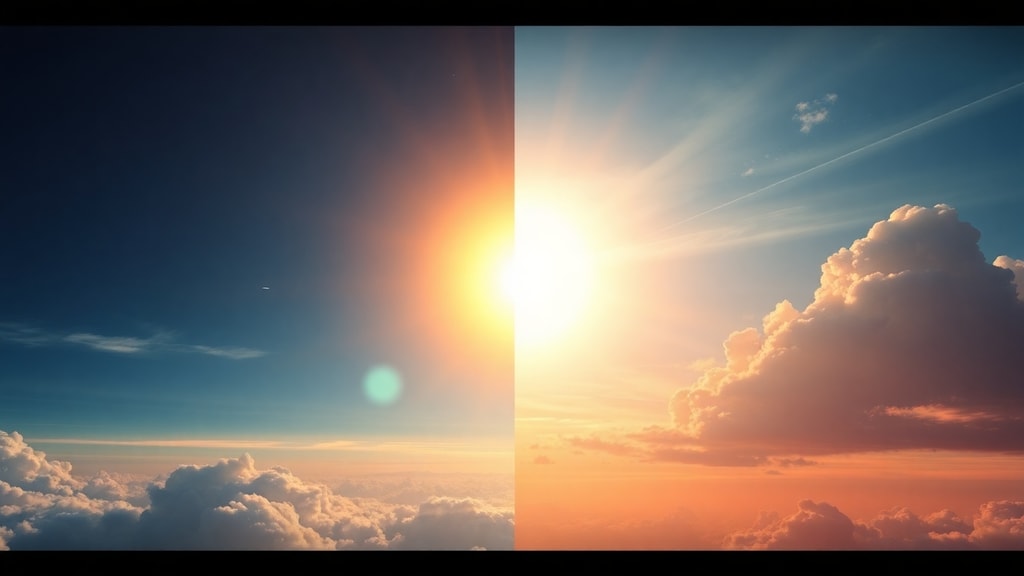
1) Introduction: What “Sky” and “Sun” Actually Are—Separately, and Together
When people say “sky vs. sun,” they usually mean a lived contrast: the sun is bright, singular, and seemingly constant—while the sky is vast, shifting, and never the same twice. But in strict terms, the two are not rivals so much as partners in a system that determines light, temperature, weather, and even mood.
**The Sun** is a star: a near-perfect sphere of hot plasma whose energy production—through nuclear fusion in its core—radiates outward as electromagnetic radiation. For life on Earth, the sun matters because it is the dominant source of incoming energy. Its output is broadly steady on human timescales, but its radiation spectrum (the mix of wavelengths) and the way that radiation interacts with Earth’s atmosphere drive what we see as “sunlight.” Even small variations, plus the effects of Earth’s changing orbit and tilt over longer periods, influence climate patterns.
**The Sky** is not a single object. It’s the visible layer of the atmosphere plus the light that travels through it and reaches your eyes. The “sky” includes multiple regions—troposphere, stratosphere, and beyond—each with different temperature gradients, humidity profiles, and chemical composition. The sky’s appearance and behavior come from processes such as **Rayleigh scattering** (why the sky is blue), **Mie scattering** (why haze and clouds can make skies pale or milky), **absorption** (what gases and particles steal certain wavelengths of light), and **cloud microphysics** (how water droplets and ice crystals reflect, refract, and block radiation).
So “sky vs. sun” is really a question of **control points**: the sun supplies energy; the sky redistributes, filters, and sometimes blocks that energy. Weather and air composition decide how much sunlight reaches the ground, what color the world looks like, and how quickly heat accumulates.
2) The Catalyst: Why This Comparison Is Trending Right Now
“Sky vs. sun” is not new scientifically, but it has become newly relevant—and newly discussable—because several global trends are converging:
1. **Solar deployment is accelerating faster than local weather intelligence.** As solar energy expands, utilities and homeowners increasingly need short-term forecasts of cloud cover, aerosol loading, smoke, and storm probability. In other words, the “sky” is becoming a key variable in the economics of the “sun.”
2. **Climate adaptation is pushing public attention toward heat and sky conditions.** Heatwaves are no longer just temperature stories; they’re stories about stagnant air, humidity, ozone formation, and cloud dynamics. People notice “how oppressive the sky feels” because the sky controls radiation and ventilation.
3. **Air-quality disruptions (wildfire smoke, dust events, and urban haze) have made the atmosphere feel personal.** When smoke dims the sun and turns skies orange or gray, citizens experience the physics in real time. Viral photos of “sun through smoke” and public heat advisories amplify this contrast.
4. **Social media and visual culture reward sky narratives.** Time-lapse videos, drone footage of storm fronts, and “sunset vs. storm” content make the sky’s variability highly shareable. The phrase “sky vs. sun” becomes a shorthand for that dramatic visual and physical transformation.
In short, the comparison is trending because the public is encountering a new kind of everyday weather literacy—one that ties sky conditions directly to energy generation, health risks, and daily comfort.
3) Deep Dive: Analytical Context, Historical Background, and Second-Order Implications
A. The Physics Beneath the Poetry
**Why the sky is blue** is the classic starting point: Rayleigh scattering by molecules in the atmosphere scatters shorter wavelengths (blue) more efficiently than longer wavelengths (red). That’s the “sky” doing the selective work.
But the moment conditions change, the “sky” changes character:
Meanwhile, **the sun** is not the problem and not the solution in most day-to-day scenarios. The sun is the energy provider; the atmosphere is the manager.
B. A Historical Lens: From Sky Observations to Modern Forecasting
Long before satellites, humans read the sky as a predictive tool. Sailors used cloud patterns to infer wind shifts; farmers interpreted sky color and horizon haze for rain odds. These practices were limited, but they were a kind of early atmospheric science.
What changed was instrumentation. Spectroscopy, balloon soundings, and later weather satellites turned sky observation into quantification: we could map aerosols, estimate humidity, detect cloud optical thickness, and model radiation transfer.
Today, the “sky vs. sun” narrative lives inside computational systems:
So the comparison is no longer only visual. It is operational.
C. Second-Order Implications: Energy, Health, Ecology, and Social Trust
The sun supplies energy, but the sky determines how much of it arrives and how fast it moves.
**1) Energy markets and grid stability.** Solar output is sensitive to cloud optical depth. A partly cloudy sky can cause rapid fluctuations—what engineers call “ramp events.” The deeper implication is that grid operators need not just sunlight forecasts but atmospheric forecasts. The “sky” becomes a financial variable.
**2) Human health and physiological stress.** The sun’s ultraviolet radiation is modified by ozone and aerosols; heat stress depends on whether the sky traps outgoing longwave radiation (a greenhouse-like effect from clouds) and how ventilation and humidity behave. People may blame the sun for discomfort, but the sky—through cloud and aerosol effects—often explains why heat feels worse or better.
**3) Ecosystem dynamics.** Shifts in cloudiness and aerosol concentrations can alter photosynthetically active radiation, affecting plant productivity. Over time, changes in atmospheric chemistry can influence crop yields and wildfire behavior, turning “sky” conditions into ecological levers.
**4) Social trust in information.** When skies turn unexpectedly—smoke surges, sudden storms, unusual sunset colors—people either accept forecasts or distrust them. Consistent, accurate sky communication becomes part of resilience.
The second-order story is that “sky vs. sun” is really about **systems thinking**: energy, health, and stability are negotiated by atmospheric conditions more than most people realize.
4) Future Outlook: Bob’s Forward-Looking Prediction
As a trend journalist observing how science meets society, my prediction is straightforward: **the market and the public will increasingly treat the sky as an infrastructure layer—not merely a backdrop.**
Within the next several years, we will likely see:
In the “sky vs. sun” debate, the sun will remain the steady protagonist in terms of energy generation. But the sky will become the headline—because it is where uncertainty, variability, and risk concentrate.
The poetic takeaway is also the scientific one: the sun gives light; the sky decides what kind of light reaches you.