Steam Deck: How Valve’s Handheld PC Redefined Gaming Portability—and What Comes Next
Published: June 22, 2026
Introduction: What the Steam Deck Is—In Concrete Terms
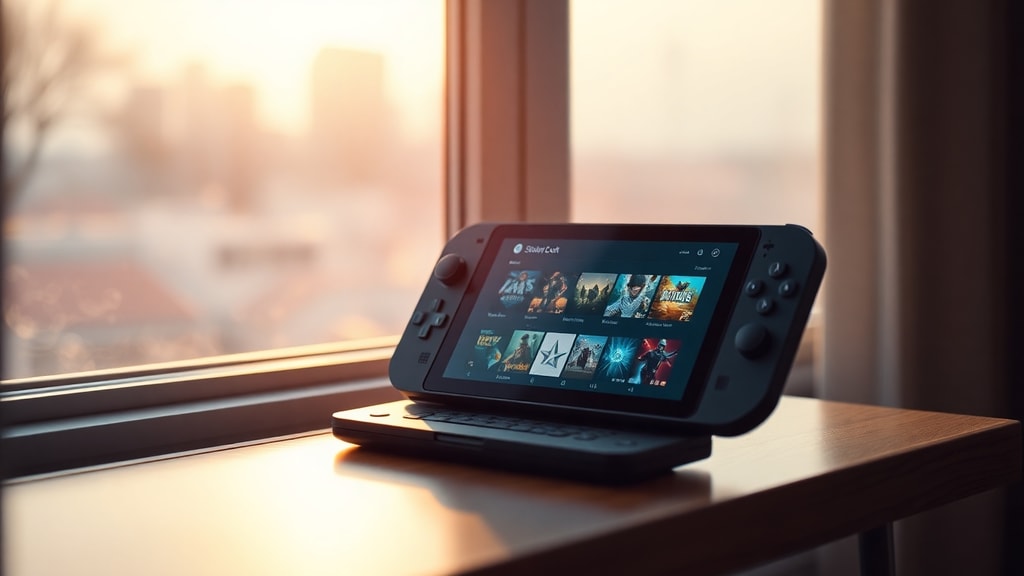
The **Steam Deck** is a handheld gaming computer built by **Valve Corporation**, released in 2022 as a purpose-designed device that runs PC games through the **Steam** ecosystem. Unlike traditional handheld consoles that rely on fixed hardware and tightly controlled software environments, the Steam Deck is essentially a **portable PC** optimized for living-room and travel use.
At the hardware level, it combines an **AMD APU** (a processor paired with integrated graphics) with fast **SSD storage**, a **7-inch touchscreen**, **built-in controls** (two thumbsticks, a D-pad, face buttons, triggers, and trackpads), and multiple connectivity options including USB-C. The device’s display, input design, and power management are tuned to balance performance with battery life—always with one overriding goal: **make “PC gaming” portable without turning it into a technical hobby**.
At the software level, the Steam Deck runs a Linux-based operating system called **SteamOS**. Rather than treating Linux as a secondary platform, Valve designed a user experience around it—most visibly through **SteamOS’s gaming-focused interface** and the ability to launch titles through Proton, Valve’s compatibility layer that enables many Windows games to run on Linux.
The result is a device that occupies a distinct category: it’s not a mere streaming client, and it’s not a full desktop replacement. It’s a **hybrid**—a console-like interface with PC flexibility. You can install games, tweak settings, connect peripherals, and use the device’s desktop mode for broader tasks, while still returning quickly to the curated Steam storefront and library. For players, it often feels like a handheld console that happens to carry the “PC back-end.”
The Catalyst: Why the Steam Deck Is Trending Right Now
The Steam Deck is trending again because the marketplace has shifted from “can it run modern games?” to “how far can handheld PC go?” Several forces have converged:
1. **Ecosystem maturity**: Over time, Steam’s compatibility technology and game verification processes have improved dramatically. More titles now work out of the box, and the user-facing experience has become smoother for both new and returning owners.
2. **Platform momentum**: Valve continues to iterate on SteamOS and the Proton compatibility layer. Even when headlines aren’t dominated by entirely new hardware, these software upgrades have a direct and noticeable impact on performance, stability, and game compatibility.
3. **A renewed handheld conversation**: Rival handhelds and PC hardware updates have kept portable gaming in the public mind. The Steam Deck, as the original mainstream reference point, naturally re-enters the spotlight whenever buyers compare “handheld PCs” rather than just consoles.
4. **Optimization culture and creator attention**: Steam Deck support has produced a whole ecosystem of guides, compatibility updates, and community troubleshooting. When new users search for “best settings,” “best performance,” or “can it run X,” they often land on Steam Deck because it has the largest breadth of documented knowledge.
In short: the Steam Deck is trending not only because it exists, but because it has become a **platform**—a moving target that keeps improving, keeps being compared, and keeps proving itself across new releases.
Deep Dive: Analytical Context, Historical Background, and Second-Order Implications
The historical problem Valve decided to solve
Before the Steam Deck, handheld gaming was largely split into two camps:
Valve’s historical advantage was that it already knew how to distribute PC games at scale. Steam had built an infrastructure not just for purchasing, but for updates, cloud saves, patch management, and compatibility tooling. The Steam Deck then leveraged that ecosystem and extended it into physical form.
The deeper bet was about **user experience design**: Valve built a handheld interface that behaves like a console menu while still letting games behave like PC software underneath. That hybridization is what made it compelling beyond raw specs.
Why Proton and Linux mattered more than most people realize
It’s tempting to obsess over the APU, resolution, and frame rates. Those matter. But the true innovation is the compatibility pipeline. Valve’s approach—enabling many Windows titles to run on Linux with Proton—turned a potential blocker into a foundation. Instead of treating Linux compatibility as a niche, Valve industrialized it.
From a journalistic viewpoint, this matters because it changes the bargaining power of developers and publishers in the portable space. A publisher may not need to build a special handheld version; they may only need to ensure the game runs reliably under common compatibility expectations. That lowers the barrier to entry for the handheld catalog.
Second-order implications: what the Steam Deck altered in expectations
1. **Portability became a spectrum, not a category.** Buyers increasingly treat handheld gaming as “how playable is it for me away from a TV?” rather than “which console do I own?” Steam Deck helped normalize the idea that portability is an extension of the same library ecosystem.
2. **Performance is now discussed as a tunable parameter.** The Steam Deck taught users to think in terms of settings—frame rate targets, resolution scaling, GPU/CPU limits, and game-by-game profiles. That mindset differs from consoles, where settings are often limited and standardized.
3. **User-driven troubleshooting became part of ownership.** Unlike sealed ecosystems, handheld PC can expose the messy reality of PC gaming: mods, launchers, overlays, anti-cheat variations, and occasional incompatibilities. Over time, however, the community’s documentation has reduced the cost of that complexity.
4. **Cloud and local gaming habits started to merge.** The Deck’s ability to use remote play and stream games, while also running locally, pushed the market toward hybrid models—where players expect seamless movement between devices and contexts.
The market signal Valve set
The Steam Deck’s existence sends a clear message: hardware doesn’t have to be bespoke and closed to be compelling. It can be flexible, community-supported, and still designed with industrial-grade usability. That signal has consequences for future handheld PCs: they must either match the Deck’s software ergonomics or deliver a fundamentally better alternative—often by improving compatibility, battery efficiency, or store integration.
Future Outlook: Bob’s Prediction for the Next Phase of Handheld PC
Here is my forward-looking forecast as a trend journalist: **the Steam Deck will evolve from “a device” into a reference platform for handheld PC experience design**, and the next wave of competition will be judged less on raw performance and more on *compatibility, power efficiency, and frictionless usability*.
Specifically, I predict three developments will dominate:
1. **Compatibility will become near-invisible.** As Proton and SteamOS mature, fewer users will need to search for workarounds. The best measure of progress won’t be headlines—it will be the drop in “does it work?” posts.
2. **Handheld PCs will standardize around flexible control and UI layers.** The Deck proved that trackpads, touch input, and a thoughtful UI can make PC control feel native. Expect other devices to adopt similar interaction patterns.
3. **More games will be designed with portable constraints in mind.** Even if developers don’t explicitly target the Steam Deck, the market pressure created by a huge portable PC user base will encourage scalable performance targets—lowering the time-to-fun for handheld players.
Valve’s handheld has already changed what consumers expect from portable gaming: they want console-level convenience paired with PC-level freedom. The Steam Deck’s lasting influence is that it normalized that pairing—so the next chapter won’t be about whether handheld PC is real, but about how *effortlessly* it becomes real for every player.