Tupolev Tu-160: Inside the Soviet-Era Supersonic Bomber That Still Shapes Great-Power Deterrence
Published: June 29, 2026
1) Introduction: What the Tupolev Tu-160 Is—And What It Represents
The **Tupolev Tu-160**, known to NATO as the **“Blackjack,”** is a **long-range, supersonic strategic bomber** built by the Soviet Union during the Cold War and later updated for modern combat realities. It belongs to a rare class of aircraft that function simultaneously as a **weapon carrier, a strategic signal, and a technological statement**: a platform designed to travel deep into enemy-relevant space with sufficient speed and reach to complicate interception and retaliation planning.
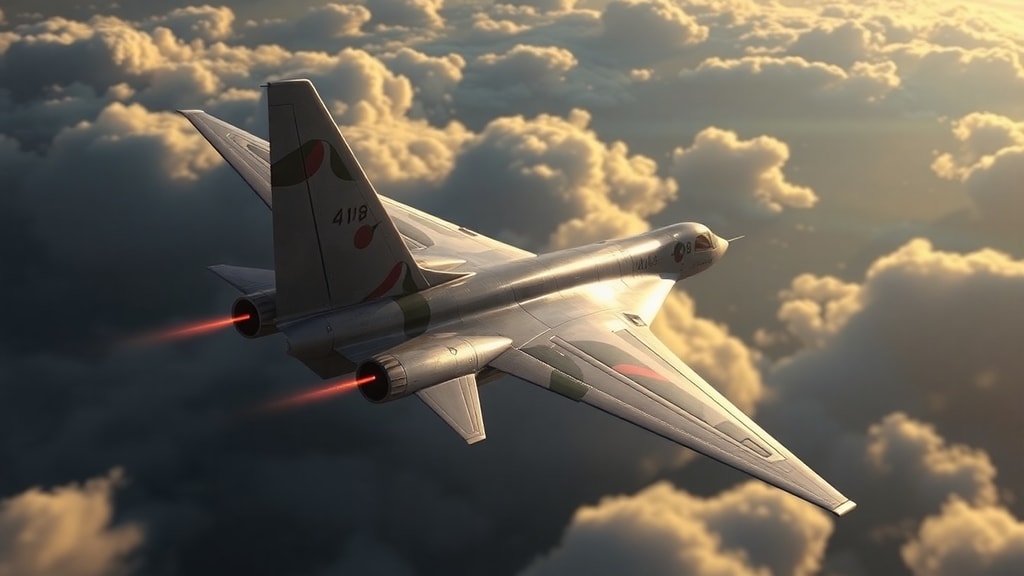
Physically, the Tu-160 is instantly recognizable. It uses **variable-geometry wings**—often called swing wings—which allow the aircraft to adjust wing sweep angles depending on speed and mission profile. In practical terms, this design offers a compromise between efficiency at cruise and performance during high-speed flight. The aircraft’s configuration is engineered to support **high subsonic and supersonic regimes**, depending on operating conditions and loadouts.
The Tu-160 is powered by **four turbofan engines**, a notable architecture for a bomber of its scale. The aircraft is also associated with an advanced strategic role: carrying long-range air-launched weapons intended for targets at distances that exceed the operational reach of many aircraft in the bomber ecosystem. As a strategic bomber, its presence is meant to communicate more than kinetic capability. It signals that a state can project power, maintain readiness for deterrence missions, and execute complex routing and timing plans.
Equally important is the platform’s place in the broader deterrence system. Strategic bombers are not merely flying arsenals; they are **air-delivered components of national military signaling**. When deployed or when exercises are announced, they can shift an adversary’s risk calculus—because bombers are both **capable of rapid mission generation** and **hard to categorize** when operating in contested airspace.
In short, the Tu-160 is a Cold War design that was never only about engineering novelty. It is a **deterrence instrument**—a machine built to be visible in capability and credible in execution.
2) The Catalyst: Why the Tu-160 Is Trending Now
The Tu-160 has resurfaced as a mainstream topic largely because of **renewed public attention to Russia’s strategic aviation capabilities**, especially as global media and analysts focus on **long-range bomber activity, modernization efforts, and nuclear-capable delivery systems**.
Two dynamics have acted as triggers.
First, reporting and imagery cycles—frequently tied to military exercises, runway operations, or patrol narratives—have drawn attention to platforms that historically were less visible to the general public. The Tu-160, because of its distinctive profile and association with strategic reach, becomes a magnet for viral analysis whenever it appears in news coverage.
Second, the conversation about the Tu-160 increasingly intersects with **industrial and technological modernization**. When a country continues to maintain, upgrade, and (in some cases) reintegrate legacy systems into updated service patterns, the aircraft turns from a “historical Cold War icon” into a **living system**. That matters for headlines: it implies not only capability retention, but also adaptation to modern air defense, navigation, communications, and targeting requirements.
Put simply, the Tu-160 is trending because it sits at the crossroads of:
3) Deep Dive: Analytical Context, Historical Background, and Second-Order Implications
Historical context: from Soviet strategic requirements to a unique design philosophy
The Tu-160 emerged from a Soviet strategic requirement: **a bomber that could outrun less sophisticated defenses and deliver weapons at distances that supported deep strategic missions**. The Cold War era rewarded airframes that could balance range, payload, and speed. Variable-sweep wings were a symbol of that thinking—capturing the aerodynamic necessity of operating across diverse flight regimes.
Unlike aircraft designs that optimize for a single “best” profile, the Tu-160 is built for **flight envelope flexibility**. That flexibility is not just a matter of aerodynamics; it influences how missions are planned, how routes are chosen, and how the bomber can respond to changing threat conditions.
Why supersonic capability matters for deterrence
From a pure engineering standpoint, supersonic performance is attractive for time-on-target concepts. But in strategic terms, the implications are broader. Supersonic flight can compress decision timelines for interceptors and planners on the receiving side. It also changes how sensors, command-and-control networks, and air defense systems manage engagement windows.
Second-order, this creates a strategic psychological effect: even when an aircraft’s actual mission is uncertain to outsiders, the perception of **speed plus range** can intensify risk. Deterrence relies on credibility, but credibility is partly built through how an adversary imagines the worst-case scenario.
Modernization: what upgrades tend to signal (even when details are limited)
Modernizing a strategic bomber is not only about keeping it flying. It usually implies improvements in:
The second-order implication is that modernization can “extend the lifespan” of a deterrence doctrine. When a platform remains current through updates, it keeps a country’s strategic posture coherent. That coherence influences not just battlefield tactics but also the structure of diplomacy, crisis bargaining, and arms control expectations.
The signaling problem: how strategic bombers affect escalation dynamics
Bombers are uniquely escalation-sensitive assets. Unlike submarines, their movement is often visible and therefore politically interpretable. Unlike certain other platforms, bombers can be presented as both training and operational readiness. This creates a communications dilemma.
In a crisis, ambiguity about intent can be dangerous. If a Tu-160 is observed in a posture consistent with deterrence signaling, the receiving side may interpret it as preparation for coercive action—especially if combined with other forms of military activity (air defense changes, naval deployments, or missile readiness cues).
This does not mean the bomber is “destined” to be used offensively. Rather, it means it sits in the category of military assets that can **compress political decision space**, because leaders must decide how to respond to uncertainty.
4) Future Outlook: Bob’s Prediction on Where the Tu-160—and Strategic Bombers Like It—Will Go Next
Looking ahead, the Tu-160’s enduring relevance will depend on two trajectories: **survivability in contested airspace** and **integration with modern strike ecosystems**.
Bob’s forward prediction is this: in the next decade, platforms like the Tu-160 will increasingly function less like standalone “penetrators” and more like **nodes in a networked strategic delivery system**—working alongside satellites, airborne sensors, electronic warfare assets, and ground-based targeting support. The aircraft’s distinctive strengths—range, speed, and payload capacity—will remain valuable, but the mission effectiveness will increasingly hinge on what it can connect to, not only what it can physically carry.
At the same time, we should expect a broader doctrinal shift among major powers: modernization will emphasize **better orchestration under threat**—improved mission planning, longer standoff delivery options, and more resilient communications. That will keep strategic bombers prominent in deterrence signaling, even as air defenses improve.
In the end, the Tu-160 is not just an artifact of the Cold War. It is a case study in how states keep strategic leverage alive: by sustaining capable airframes, updating them for contemporary threats, and understanding that deterrence is as much about perception and timing as it is about metal and engines.