Utah Fires: When Fast-Spreading Wildfires Meet a New Climate Reality
Published: June 20, 2026
Introduction
Utah fires are wildfires burning across the U.S. state of Utah—incidents that can range from small, rapidly contained brush blazes to large, fast-moving infernos that threaten towns, highways, power lines, watersheds, and ecosystems. To understand what “Utah fires” really means, it helps to picture the geography and living conditions that make Utah both fire-capable and highly vulnerable. Much of Utah is mountainous, with communities nested in valleys and along forested slopes. The state also contains extensive wildland-urban interface (WUI) zones—areas where homes and infrastructure are mixed with flammable vegetation such as grasses, brush, and pine forests.
In practical terms, Utah fires are monitored and fought by a layered system: local fire departments, state agencies, federal partners such as the U.S. Forest Service and Bureau of Land Management, and emergency management organizations coordinating evacuations, road closures, and resource allocation. Fire behavior is influenced by terrain and weather—especially wind patterns in mountain corridors, the steep slopes that allow flames to climb, and seasonal drought that dries out fuels. Smoke also becomes part of the story: even when the flames are at a distance, wildfire smoke can degrade air quality across entire regions, affecting schools, workplaces, and people with asthma and cardiovascular conditions.
As a global trend journalist looking at why a local phenomenon spreads across headlines, Utah fires serve as a case study of a broader shift: wildfire risk is no longer just a seasonal problem. It has increasingly become a recurring, compounding threat that intersects with climate trends, land management, emergency readiness, housing policy, and public health.
The Catalyst
Utah fires are trending right now for a straightforward reason: conditions have combined in ways that accelerate ignition and spread, and the public has noticed—often because impacts are visible, immediate, and closely connected to daily life. Recent wildfire seasons across the western United States have featured repeated episodes of hot temperatures, low humidity, dry vegetation, and wind events that help fires surge across ridgelines. When a wildfire threatens populated areas, triggers evacuations, forces major road closures, or sends smoke into urban corridors, it becomes “news” in the strongest sense: it disrupts schedules, travel, health, and economic activity.
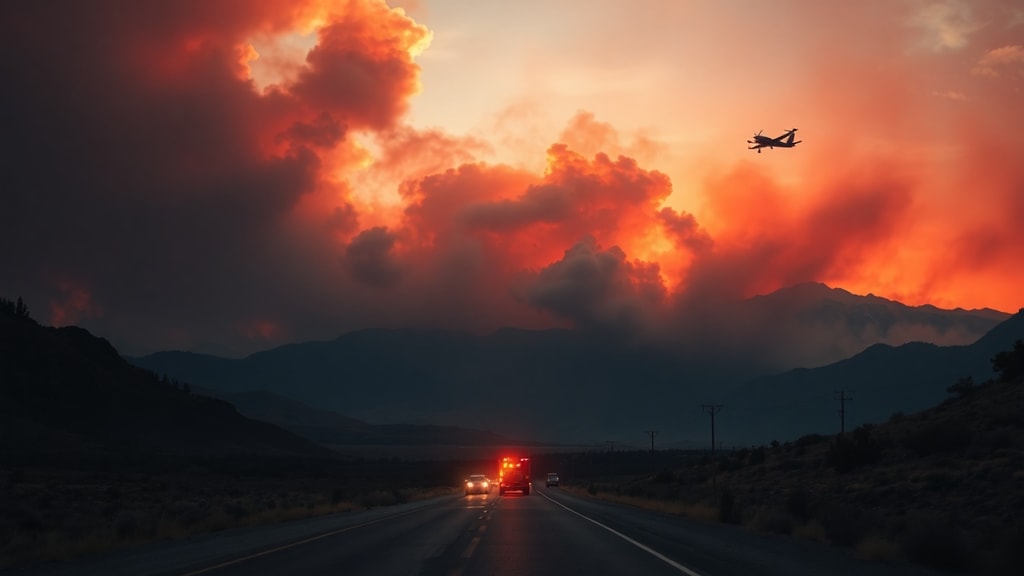
The trigger is not a single headline; it is the pattern of rapid developments that modern media and social platforms amplify. A wildfire can ignite, expand, and shift direction within hours—while communities, businesses, and families are simultaneously checking alerts. In Utah, where many communities are close to mountainous and forested terrain, a fast-moving fire can turn an ordinary day into an emergency briefing. When evac notices spread, when helicopters or aircraft are deployed, and when air-quality alerts peak, the topic naturally surges into public attention.
That is why “Utah fires” is trending: it reflects a convergence of (1) active incidents, (2) severe smoke and health advisories, and (3) the reality that the window for effective suppression can be extremely narrow when fuels are critically dry.
Deep Dive
1) Historical context: from episodic disasters to repeated system stress
Wildfire is not new to Utah. Indigenous land management practices, early settler patterns, and decades of forest and brush dynamics all shaped historical fire regimes. Many ecosystems experienced natural or culturally influenced burning that—at certain times—maintained a more balanced landscape of vegetation age and density.
However, over the last century, large-scale fire suppression policies—designed to protect property and life—reduced the frequency of small, low-intensity burns in many areas. The second-order outcome is fuel accumulation: more vegetation becomes available to burn when a long drought and heat arrive. This doesn’t mean every wildfire is “caused by suppression,” but it does mean the baseline conditions are often less resilient to ignition.
In parallel, population growth near fire-prone lands expands the stakes. The wildland-urban interface grows, and so does the number of structures that can be threatened. That is why modern Utah fires can be especially consequential: they do not merely affect wilderness; they challenge emergency services and utilities that serve urban and suburban populations.
2) Why the fires behave the way they do: wind, topography, and dry fuels
In Utah’s terrain, fire has a physical advantage. Steep slopes can preheat vegetation upslope, making ignition easier. Wind can align with valleys and passes, pushing flames and embers into new areas. In dry conditions, even small spot fires—embers carried by wind—can outrun crews and ignite fresh pockets faster than containment lines can be established.
This is where the “second-order” implications emerge. When a fire outpaces suppression efforts early, the response shifts from containment to life and asset protection. Resources then concentrate on defensible evacuation corridors, critical infrastructure, and neighborhoods with the highest exposure. That change in strategy can ripple outward: staffing is stretched, aircraft deployments are diverted, and smoke management becomes as urgent as flame control.
3) Public health and infrastructure: smoke is a parallel emergency
Smoke is not merely an inconvenience—it is a systemic health risk. Fine particulate matter (PM2.5) penetrates deep into lungs and can worsen asthma, trigger respiratory inflammation, and strain people with pre-existing cardiovascular disease. Hospitals may see spikes in respiratory complaints, schools may suspend outdoor activities, and productivity can drop even in communities not directly threatened by flames.
From an infrastructure perspective, Utah fires can also stress electrical systems and communications. Power lines are both potential ignition sources and vital services that communities rely on for alerts, refrigeration, medical devices, and emergency shelters. In extreme conditions, shutdowns and repairs become more complex, especially when access roads are blocked or personnel can’t safely reach damaged sites.
4) The governance problem: preparedness is not just firefighting
The “governance” layer is where many societies struggle. Fire response is visible, but prevention is political and long-term. Effective risk reduction may involve thinning and controlled burns, improving defensible space around structures, upgrading building materials and roof/vent screening, and ensuring evacuation routes remain functional under surge conditions.
Yet these measures face obstacles: funding cycles, land ownership complexity, environmental constraints, and community differences in willingness to change landscaping or building practices. In Utah, where picturesque mountain-adjacent living is a draw, the cultural preference for certain property aesthetics can conflict with best practices for fire-resistant landscaping.
The deeper trend implication: as wildfire seasons intensify, communities will increasingly measure “resilience” by how quickly they can transition from normal operations to evacuation-ready systems—without assuming the fire will behave predictably.
Future Outlook
Looking ahead, my prediction is that Utah fires will increasingly act like a recurring “infrastructure event,” not a one-off environmental disaster. That means two things will become dominant.
First, the integration of early warning and real-time decision support will accelerate. Expect more widespread use of high-resolution fire behavior modeling, satellite-driven detection, and automated air-quality forecasting that links smoke projections to school and workplace policies. The public will get fewer generic warnings and more actionable guidance—who should prepare, where conditions are likely to worsen, and what routes remain viable.
Second, prevention will shift from optional add-ons to standardized expectations in the wildland-urban interface. Over time, wildfire-resistant building codes, defensible space requirements, and clearer insurance incentives will likely intensify—because economic consequences (property damage, health costs, interruption of utilities) will become too large to treat as rare anomalies.
If Utah’s leaders and residents can translate lessons from each fire—about terrain-specific risks, evacuation readiness, and smoke mitigation—then the long-term outcome can improve even when climate-driven ignition and dryness cannot be fully controlled. But the baseline reality is changing: the “next fire” is no longer a distant possibility. It is a planning assumption.
In that sense, Utah fires are not only a local story of flames and smoke. They are a mirror held up to modern risk—how societies adapt when the environment moves faster than policy cycles.