Wimbledon, Explained by Bob: How the Oldest Grand Slam Became a Modern Media Powerhouse
Published: June 28, 2026
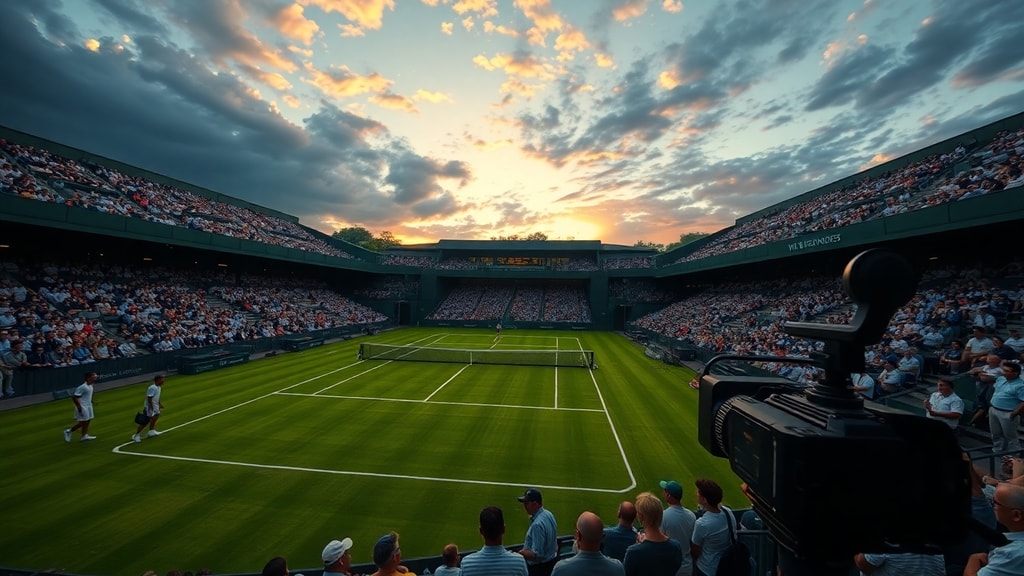
Introduction: What Wimbledon Is—In Concrete Terms
Wimbledon is the annual grass-court tennis championship held at the All England Lawn Tennis and Croquet Club in Wimbledon, London. It is one of tennis’s four Grand Slam tournaments—alongside the Australian Open, the French Open (Roland-Garros), and the US Open. What makes Wimbledon distinctly identifiable, even to people who rarely watch tennis, is the fusion of **sporting discipline** with **ritual and architecture**: the slow-burning, methodical pace of grass court play; the iconic Centre Court and No. 1 Court atmospheres; the tradition of **white clothing** and **formal match ceremonies**; and the tournament’s emphasis on etiquette and continuity.
In terms of format, Wimbledon’s competition is run through a bracket system culminating in singles finals for men and women, with doubles and mixed doubles events running in parallel. Players progress round by round from the early stages to the championship matches, navigating best-of-five sets for men’s singles (a key technical distinction among Grand Slams) and best-of-three sets for women’s singles. The grass surface—shorter ball contact and lower bounce compared with clay and hard courts—generates a different tactical vocabulary: serve-and-volley instincts, slice variations, and the constant demand for precision under pressure.
But Wimbledon is also an institution beyond match play. It is a long-standing organizational and cultural system that has managed complex logistics year after year: scheduling on public holidays and peak weekday viewing cycles; groundskeeping to maintain playable grass quality; player accommodations and practice-court arrangements; ticketing operations with international demand; and stringent broadcast and media credentialing. In short, Wimbledon is simultaneously a tennis tournament, a brand, and a production machine.
To treat Wimbledon merely as “a tournament” is to miss how it operates in the wider media ecosystem. Wimbledon’s role in global sport today is as a **heritage-led platform**—one that influences what fans expect from coverage, storytelling, and spectator experience, including how emotion is packaged across television, mobile feeds, and social media.
The Catalyst: Why Wimbledon Is Trending Right Now
Wimbledon is trending in the current cycle because it aligns with a rare convergence of factors: **the return of peak, in-person summer sports viewing after shifting schedules in recent years; heightened global attention on elite athletes at the same moment their seasons overlap with fan culture; and sustained viral circulation of Wimbledon-specific moments**—from championship points to crowd reactions to the iconic strawberry-and-cream spectacle.
In the last few weeks of any modern Wimbledon season, the “trigger” for mass conversation typically isn’t only the tennis itself. It is the way Wimbledon’s content ecosystem accelerates visibility. A handful of moments—an upset that breaks pre-tournament expectations, a breakthrough by a rising player, a dramatic five-set swing, a rule-related controversy, or a historic performance—become “event anchors.” Then broadcasters and digital channels amplify those anchors through clips designed for short attention spans while also feeding longer-form analysis for committed fans.
Additionally, Wimbledon’s ongoing modernization—without abandoning tradition—creates a built-in news narrative: every year it must answer a difficult question in public. How do you preserve an image of timeless elegance while operating in a world of instant replays, algorithmic discovery, and platform-first distribution? The fact that Wimbledon continues to do this competently is itself a reason people search, watch, and discuss.
Finally, there is a strategic timing element. Wimbledon sits in the calendar as a high-visibility prelude to other global summer sports and cultural moments. It captures audiences who are ready for a “major event” after earlier seasonal tournaments have narrowed. The result is a predictable spike in attention—yet always renewed by the unpredictability of match outcomes.
Deep Dive: Analysis, History, and Second-Order Implications
Wimbledon’s history matters because it functions as credibility. The All England Club tournament predates modern tennis branding conventions, yet its longevity has made it the sport’s benchmark for legitimacy. When a Grand Slam has endured for more than a century, its rituals become a kind of contract with the audience: you know what kind of experience you are getting.
Historically, grass courts have been Wimbledon’s defining technical identity. This isn’t just a surface choice; it’s an engineering of difficulty. Grass changes ball skid, speed, and bounce, which means players’ careers often hinge on their ability to adapt to it. That adaptation affects second-order outcomes—selection strategies, training emphasis, and the biomechanics of movement patterns. In the modern era, where many top players train extensively on hard courts and on court-specific regimes, grass acts as both a test and a filter. Wimbledon becomes a tournament that can rewrite rankings narratives not merely through wins and losses, but by revealing how well athletes can translate their strengths into a different physical language.
Now consider the institutional side. Wimbledon’s traditions—white kit, strict dress codes, ceremonial presentation—are sometimes described as “conservative.” But in media economics, tradition is not the opposite of innovation; it can be the foundation that makes innovation legible. Wimbledon’s digital and broadcast transformation operates within visible boundaries. That means when Wimbledon experiments—whether through camera angles, interactive broadcast features, or social-first distribution—it is still read through the lens of continuity.
This is where second-order implications emerge.
1) **Heritage as a marketing strategy that reduces trust costs.** Fans are more willing to follow a platform when its identity feels stable. Wimbledon uses its stable identity to lower skepticism, which improves engagement rates and subscription value for broadcasters and streaming partners.
2) **Algorithmic discovery reshapes what counts as “the match.”** In a world where highlights are clipped into seconds-long loops, the definition of significance can shift. The pivotal point is not only the one that decides the match—it is the one that produces the most shareable reaction, the clearest tactical lesson, and the most emotionally readable outcome. That changes how athletes may experience their own performances: the crowd’s response and the clip’s legibility become strategic side effects.
3) **The sport’s global talent pipeline accelerates.** Wimbledon’s worldwide visibility reinforces pathways for players from outside traditional tennis power centers. The more a Grand Slam becomes a media event, the more scouting, sponsorship, and training investments follow global narratives. It’s no longer just “who is best”; it becomes “who is visible.” Wimbledon’s reach can turn a breakthrough into funding, coaching upgrades, and competition opportunities.
4) **Production standards rise—raising costs and expectations.** Wimbledon’s excellence in broadcast and event management pushes competitors to match quality. Over time, that increases the baseline for what fans expect from other tournaments: camera clarity, commentary depth, and statistically informed storytelling.
Crucially, Wimbledon’s impact is not confined to tennis. Sports organizations across the world watch Wimbledon because it demonstrates a template: preserve distinctiveness, modernize delivery, and convert cultural signals into audience trust.
Yet there is tension. Tradition can be a constraint when technology demands flexibility—on scheduling, officiating systems, or content policies. Wimbledon must continuously calibrate how much novelty it can introduce without diluting the qualities that make it feel singular. The successful version is subtle: innovation without erasure.
Future Outlook: Bob’s Prediction for Wimbledon’s Next Phase
My forecast is that Wimbledon will deepen its role as a **heritage-led media platform** rather than merely a tennis venue. In practical terms, that means three likely developments.
First, Wimbledon will continue to expand its data-informed storytelling—turning serve patterns, rally dynamics, and surface-specific analytics into content that can be consumed both by casual viewers and hardcore fans. Expect more “explainable tennis” moments: not only what happened, but why it mattered.
Second, Wimbledon will invest further in multi-platform viewing experiences that respect the tournament’s rhythm. The challenge will be to keep clips from flattening drama into noise. The winning strategy will be to preserve narrative depth even in short formats—so that a 30-second highlight still points viewers toward the full match story.
Third, Wimbledon will likely strengthen its global cultural partnerships, not as a concession to trendiness, but as a method of sustaining long-term international audiences. The next generation of Wimbledon engagement will be built through community—local tennis programs, influencer-style coaching narratives, and youth-focused access moments—while still keeping the sacred atmosphere of Centre Court intact.
Wimbledon’s paradox has always been that it must be both timeless and current. In the coming years, I expect it will solve that paradox by treating tradition as the organizing principle, and technology as the delivery mechanism. If that holds, Wimbledon will remain what it has become: not just the sport’s summer crown, but an editorial benchmark for how major events should look, sound, and feel in the modern attention economy.