Wimbledon’s Quiet Revolution: How Tennis’ Oldest Stage Is Becoming the Tech, Data, and Sustainability Benchmark
Published: June 26, 2026
Introduction: What Wimbledon Is—and Why It Matters
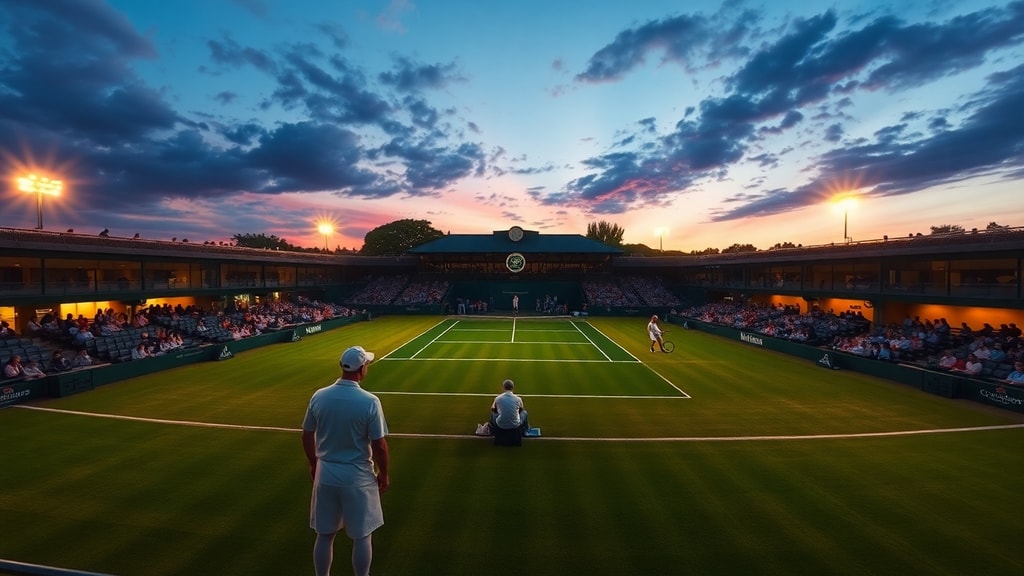
Wimbledon is the oldest and widely regarded most prestigious tennis tournament in the world. Officially known as “The Championships, Wimbledon,” it is held annually on the All England Lawn Tennis and Croquet Club grounds in Wimbledon, London. The event is played on grass courts, a surface that produces a distinctive style of play: lower ball bounce, faster skids, and a premium on serve-and-volley tactics and precise timing. Wimbledon’s status is also anchored in ritual and tradition—white clothing requirements for players, strict decorum for the grounds, the iconic Centre Court and its retractable-roof upgrade, and the ceremonial cadence of the tournament week.
But Wimbledon is not a museum piece. It is a modern sports organization operating under intense media scrutiny and commercial pressure while maintaining brand discipline that fans recognize instantly. That tension—between heritage and innovation—is central to how Wimbledon functions as more than a sporting event. It is a global stage where broadcasters, data providers, sponsors, technology vendors, and operations teams coordinate complex systems in real time, from scoring and officiating technology to digital ticketing and fan engagement platforms.
To understand why Wimbledon commands such attention, it helps to grasp its position in the tennis ecosystem. The Championships sits alongside the Australian Open, French Open, and US Open—yet grass courts make it uniquely difficult to generalize player performance across the season. Wimbledon therefore operates as both a sporting test of adaptation and a media production challenge, because the entire ecosystem must translate a fast-changing, low-bounce sport into a broadcast experience that still feels clear, fair, and immediate to viewers everywhere.
The result is a tournament that is historically revered and operationally sophisticated—an intersection that increasingly draws journalists and technologists alike.
The Catalyst: Why Wimbledon Is Trending Right Now
Wimbledon is trending right now for a familiar reason—people feel the season’s peak approaching—but the trigger is more specific and more contemporary: the Championships are being discussed simultaneously in sports media and technology circles because the tournament continues to expand the way it measures play, tracks the match, and delivers it to audiences.
In recent cycles, several converging developments have intensified attention:
1) **The race to improve officiating and line-calling accuracy** has remained a hot topic across elite sports, and Wimbledon’s broadcast ecosystem keeps that conversation alive by showcasing high-precision visuals and rule-driven match arbitration.
2) **Fan expectations for real-time data** have risen sharply. Viewers now want not only the score and highlights, but also context—serve speeds, return metrics, momentum indicators, and tactical breakdowns. Wimbledon, as a global brand, becomes the proving ground for how well tennis can be explained in the moment.
3) **Sustainability scrutiny** is escalating in major events. With London and the wider UK tightening environmental expectations and with sponsors increasingly pressured to show measurable impact, Wimbledon is being covered as part of the broader sports sustainability narrative.
4) **Broadcast and streaming competition** has become more intense. Tennis is uniquely suited to innovation because it is continuous, predictable in structure, and highly visual. Any improvement in camera angles, graphics, pacing, or accessibility can change the viewer experience enough to generate meaningful online discussion.
Taken together, these factors explain why Wimbledon doesn’t just “trend when it’s on.” It trends because people are watching the Championships as a real-world example of how an old institution is being upgraded—quietly, year after year.
Deep Dive: Analytical Context, History, and Second-Order Implications
Wimbledon’s historical dominance was built on tradition: grass courts, strict etiquette, and an emphasis on the sport’s aesthetics and discipline. Yet history also matters because Wimbledon’s traditions create constraints—constraints that often stimulate innovation rather than block it.
A historical lens: why grass is both romance and systems pressure
Grass courts make Wimbledon a special case. The surface is notoriously variable: it changes throughout the day and across the tournament, and it responds to weather in ways that are more complex than hard courts or clay. That variability means players and officials must operate with a higher level of situational awareness.
From a technology and operations viewpoint, that creates second-order pressure on the whole event system: the tournament must be consistent in how it tracks performance, ensures fairness, and communicates decisions. Even small upgrades in line-calling, ball tracking, and broadcast graphics can have outsized impact because the sport is faster and the margin for error is smaller.
The modern turning point: Wimbledon becomes a data-to-meaning pipeline
Many tournaments can show data. Wimbledon increasingly aims to convert data into meaning.
That distinction matters. “Meaning” is what fans feel: clarity about why a point swung, how a player’s strategy changed, and what tactical adjustments are working. Turning raw measurements into explanation requires a layered approach—collection, validation, transformation, and presentation.
Second-order implications follow:
The “heritage-first” brand strategy—innovation without breaking the spell
A frequent misconception is that innovation in elite sport means disruption. Wimbledon’s approach is different: it upgrades the invisible parts of the experience while preserving the ritual that fans come for.
This heritage-first strategy has its own market implications. When organizations modernize operationally but keep cultural continuity intact, they reduce brand fatigue. That makes Wimbledon a global template for how legacy institutions can remain credible while adopting new systems.
Sustainability as performance: the operational scoreboard
Sustainability in sports is sometimes treated as marketing—yet Wimbledon’s scale makes it an engineering and logistics problem.
Second-order effects appear in how sustainability intersects with other priorities:
When sustainability becomes operational rather than symbolic, it is harder to reverse—and that makes Wimbledon’s efforts influential far beyond tennis.
The broader tennis ecosystem: grass as a global stress test
Wimbledon’s innovations also serve as a stress test for tennis worldwide. The sport’s governing bodies and commercial partners can observe what works when the stakes are maximal and the audience is global.
Grass is not a universal surface; many players do not grow up on it. Yet Wimbledon’s success with high-clarity broadcast and consistent match presentation creates a model for how to make any sport legible to a worldwide audience.
Future Outlook: Bob’s Prediction—Wimbledon Will Become the Default Reference for Sports Modernization
My forward-looking prediction is straightforward: Wimbledon will increasingly function as a reference architecture for modern sports events—where tradition provides emotional continuity, and technology provides operational clarity.
Within the next few years, expect three shifts to solidify:
1) **More match intelligence in the broadcast layer.** Not just stats, but interactive, narrative-driven context—explaining patterns as they happen.
2) **A tighter feedback loop between fan expectations and operational upgrades.** Wimbledon will treat digital experience as part of the competition’s “on-court” quality, not a separate marketing layer.
3) **Sustainability performance metrics to become visible and auditable.** Fans and sponsors will demand evidence, and Wimbledon’s scale makes it uniquely capable of producing credible benchmarks.
If that happens, Wimbledon won’t only remain tennis’s crown jewel—it will become the benchmark others measure themselves against: the place where the world sees how legacy can modernize without losing its soul.